Cattle Guards from Barn World

Barn World has a large selection of cattle guards to give you free vehicle access to your pastures while keeping your livestock contained. There are many different styles, sizes, ratings and options available and we detail some of them below.


cattle guard on concrete footings  cattle guard being removed from optional box

Private Driveway Cattle Guards

As an option for use on private land such as driveways and ranch entrances, we offer an economical option called the private use cattle guard.

These are built with an estimated load-carrying capacity of 12 tons per axle, plenty for fully loaded semis and typical farm and ranch equipment.

They’re made with round top pipe welded to a steel c-channel below that transfers the weight of crossing vehicles to the ground below. They’re available with many options including:

  • wings to tie the fence line to the guard
  • removable box so it can be removed from the site or easy cleaning
  • integral box, welded to the guard so it can rest directly on the ground
  • available in 6′ or 8′ in the direction of travel and may be bolted together

When you need a gate-less entry for your ranch or driveway, this is the most common and economical way to go!

Rated Cattle Guards

An HS-20 rating is required when installing a crossing in a public roadway. This is a 16 ton per axle load-carrying engineered design. It’s a very common certification used throughout the US for highways and public roads

We offer the HS20 Rated Cattle Guards in both Round and Flat Top Rail designs.

Below are the American Association of State Highway Transportation Officials load rating classifications. This organization represents the highway and transportation departments for all 50 states and creates a comprehensive industry standard for public road projects.

Cattle Guard Load Ratings

Click any one of the links above to be taken to the appropriately rated cattle guard on our site. Please let us know if you have any questions.

Cattle Guards Options

Not every site has the same needs. Some need to allow high speed traffic to cross and will want a ‘flat top rail’ design. Others are in very remote areas with low traffic and can use the boxed guard shown below. This design allows it to sit directly on the ground and have dirt ramps on either end for vehicle crossings.

The opposing option is the ‘removable box’. It’s not the best name for this feature as the box stays, but the guard is removed. This allows the box to preserve the surrounding site and keeps it from being disturbed. If you lift the guard out, cleaning underneath is a lot easier.


boxed cattle guard for laying directly on the groundcattle guard removable box option

Snow plow strips

Plow strips are added as shown below for areas that use snow plows. The strips are welded to the top allow the plow to glide across without clipping across the top of the rails. The plow operator sure appreciates the smoother crossing and it can help minimize wear and tear on the plow and guard.

plow strips on a cattle guard

Whatever your particular need is, there’s a cattle crossing solution for you. Please let us know if you have any question or if we can help select a livestock guard for your site.

We can also email quotes with shipping right to your site.  Just email Sales@BarnWorld.com or call anytime: 720.238.2190.

Facebooktwitteryoutube

Types of Cattle Guards Delivered

There are many names for what we call a cattle guard. The traditional design is a steel grid of parallel bars set in the ground. They create unstable footing for hoofed animals like livestock and prevent them from crossing. The guards are installed instead of a gate to keep cattle from wandering off of your land.

Below are some of the various designs available that eliminate the need for a gate.

Concrete Cattle Guards

Not all of these barriers are made of steel. There are concrete cattle guards available as well. This type uses forms to allow them to be poured on site. This makes them more economical to ship than the steel guards.There’s even a reusable concrete cattle guard form that allows you to pour as many as you like! Simply set the re-bar in the holders and fill with cement. Wait for them to cure and remove the finished guard from the form.


concrete cattle guards ready to be installed  concrete cattle guard form


Steel Cattle Guards

The most popular cattle guard design is made from steel. The top rails are welded so they run perpendicular to the road and are supported beneath by steel beams. The beams are set on concrete foundations to transfer the vehicle weight to the ground.

Round Top Rail Cattle Guards

cattle guard made from round top pipe rails

This popular design uses pipe for the top rails. The rounded surface creates extremely unstable footing for a large flat hoof and a very effective deterrent to livestock. It doesn’t provide the smoothest ride for crossing vehicles but are generally more economical than the flat top rail design below. They’re a bit more aggressive as a deterrent as well.

The installation diagram below illustrates how a crossing is supported in the roadway. Notice the wings on each side that transition the vertical fence line barrier to the horizontal livestock barrier in the road itself.

cattle guard installation diagram

Flat Top Rail Cattle Guards

The flat rail design uses a top rail shape of a hexagon. A flat top that the moves first outward than down like the profile of a barn. See the detail of the rail ends in the picture below.

cattle guard with flat top rails

This style is available in a load-carrying rating of 12 tons per axle all the way up to a massive 30 tons per axle. Note that the Department of Transportation requires only 16 tons per axle for public roadway projects.

Precast concrete foundations

The flat rail is able to have precast footings shipped with the guard. The manufacturing site also produces these specialized footings near the same facility. The footings and guards are loaded and delivered on the same vehicle. The concrete has re-bar pre-cast into the form so the metal grid can be bolted down directly in the field. It’s very convenient and saves pouring cement on-site.

Cattle Guard Delivery

All of the steel grid designs require that the receiver provide a mechanical means of unloading upon arrival. The large sizes and extremely heavy weights aren’t able to be unloaded by hand. The delivery driver also doesn’t have a way to unload the guards or foundations from the delivery vehicle and will rely on the customer to unload.

The cattle guard concrete forms are light enough to be delivery and managed by hand.

If you have any questions about your project or would like a quote with shipping to your site, please let us know and we’ll be happy to help!

Barn World – Sales@BarnWorld.com – 720.238.2190


Facebooktwitteryoutube

Cattle Guard Information from Barn World

Buying a cattle guard doesn’t have to be complicated. You want to make sure you make the correct selection for your site and have it properly installed.

Selecting a Cattle Guard

There are many different styles and ratings to choose from but making your selection based on the type of traffic is a good place to start. If you anticipate higher-speed traffic, you might want to consider the flat, top rail design.

Flat Rail cattle guards

The flat top rails allow vehicles to cross at a higher rate of speed than the round rail guards. They are still an effective livestock barrier by spacing the rails far enough apart that hoofed animals can’t gain any secure footing. The space also allows cattle to see to the bottom of the vaulted area beneath which creates and optical discomfort as well.

flat rail cattle guard

Round Rail Cattle GuardS

This design is very popular and typically more economical than the flat. They are also a more aggressive livestock barrier. The curved surface provides a more unstable footing as a flat hoof is difficult to balance on the round rail.

cattle guard with round top rails

This is great for keeping livestock from crossing, however it’s a bit harder on higher speed crossing vehicles. The round rails create more of a rumble and may not be appropriate for high-speed highway use.

Comparing flat and round top rail designs

Choosing the right cattle guard design is essential for balancing vehicle access and livestock control. The two most common styles, flat top rail and round top rail, each offer distinct advantages suited to different applications.

Flat Top Rail Cattle Guards are designed for smoother vehicle crossings, making them ideal for high-traffic areas and roadways where comfort and speed are priorities. The flat rails provide a more stable surface for tires, reducing vibrations and wear on vehicles. This design is particularly beneficial for farms, ranches, and commercial properties with frequent truck and equipment movement, ensuring a safe and efficient passage without sacrificing durability.

Round Top Rail Cattle Guards offer a more aggressive deterrent for livestock, making them effective in areas where animal containment is the primary concern. The curved rail structure creates a less stable footing for hooved animals, discouraging attempts to cross. While this design enhances livestock control, it can lead to a slightly rougher ride for high-speed vehicles when compared to the flat top rail alternative.

Both designs are effective livestock deterrents and are available in both standard and heavy-duty load ratings. They are each designed to accommodate various traffic needs, from farm vehicles to fully loaded-semi-trucks. Additionally, both styles are designed for year-round outdoor use and ensure longevity in all weather conditions.

Ultimately, the decision between a flat top or round top rail cattle guard depends on whether the priority is vehicle comfort or livestock containment. For smoother, high-speed crossings, the flat top rail is the preferred choice, while the round top rail remains the superior option for deterring even the most stubborn livestock.

Cattle Guard Options

Cattle Guard Wings

To prevent your livestock from walking around the ends where the fence line meets the guard, a wing is installed. This takes the horizontal fencing barrier and transfers it to the horizontal guard in the ground. The wing will bolt to the bottom of the grid and the triangle design connects to the fencing to complete the barrier.

Cattle guard wings are an essential addition to ensure livestock cannot bypass the barrier by walking around its ends. These metal extensions connect the fence line to the cattle guard, directing the horizontal fencing downward to meet the guard’s structure.

Designed in a triangular shape, they bolt securely to the cattle guard, forming a seamless connection that prevents animals from finding an open path. By eliminating gaps in the fence-to-guard transition, wings enhance the effectiveness of the barrier, providing reliable containment without requiring additional gates.

cattle guard wing installed

Cattle Guard Foundations

Pre-cast concrete foundations allow you to simply set them in place and bolt the guards down to complete the installation. These very large and heavy optional concrete footings make setting up your barrier a breeze. They ship with the flat top rail guard and take the most difficult part of the installation and make it very straightforward.

Installing a cattle guard requires a solid foundation to support heavy loads and maintain long-term stability. Precast concrete foundations offer a practical solution by providing a ready-made base that eliminates the need for on-site pouring and curing. These heavy-duty footings are engineered to withstand extreme weight and weather conditions, ensuring a durable, long-lasting support system.

By bolting the cattle guard directly to the precast foundation, installation is streamlined, reducing labor and ensuring proper alignment. This approach not only saves time but also improves the overall strength and functionality of the barrier.

cattle guard set on a precast concrete foundation

For help choosing the correct guard for your site, please call or email and we’ll be happy to help.

Barn World  (720) 238-2190  Sales@BarnWorld.com

Facebooktwitteryoutube

ATV Cattle Guards from Barn World

Barn World carries a variety of cattle guards and livestock equipment for your every need and now has an ATV cattle guard.

cattle guard for atvs

This unique design allows for a quick and easy method of allowing your ATV to move through your fence lines without opening a gate. The best thing is, there’s not special installation work that needs to be done. It really is a set-in-place barrier.

Ease of Installation

This design makes installation as simple and easy as possible. There’s no need to dig a hole!  Simply cut your fence and lay the cattle guard on the ground. Once in place, just re-connect your fencing to the upright stanchions and it’s ready to use, you’re done!

There’s no need to dig a hole, install a foundation or even hire a contractor. This one-piece design allows even the hobby rancher to simply drop it in place. There really isn’t anything to do other than to set it in place.

Suggestions for Setting Up

The area where he guard will rest should be clear of weeds and free from standing water.

Make sure the area is able to shed water to prevent the guard from sinking into the ground. Standing water will also contribute to corrosion and should be avoided to promote the longest useful life possible. The simple addition of crushed gravel to create a ‘French Drain’ to move water way from the crossing is well worth the time of installing.

The other suggestion is to kill the grass or weeds directly under and around the site. You want the animals to be able to see the barrier.  Just the sight of the rising metal rails is usually enough to prevent animals from wanting to cross. If it’s overgrown with weeds, you loose the visual warning and they could accidentally stumble into the guard unknowingly.

Clear the ground of weeds, lay down a weed barrier and keep the area mowed if necessary. It’s an easy job to drag the guard out and replace if needed to clear any undergrowth.

Specifications:

  • 1-1/2 x 11 gauge square tubing
  • 72″ wide X 91″ long
  • Ramp is 14″ tall
  • Overall width of the guard including the wings is 87″
  • Comes standard with a grey enamel finish

Pictures of the ATV cattle guard

atv cattle guard  an atv on a cattle guard  atv on a cattle guard

We are able to stack this unique design to help with shipping rates. We are able to get up to three in a single bundle for the most economical rates when shipping in the lower 48 states. Larger quantities will qualify for better L-T-L (less-than-truckload) rates.

Surprisingly, we’re able to ship most of our cattle guards in small quantities. The thing to remember is that once they arrive on-site, you’ll need to provide a mechanical (forks) means of unloading.

The weights and sizes are such that the drive won’t have a means of removing them from the vehicle. The two seat design weighs approximately 300 pounds while the longer 4-place design weighs a bit more.

Barn World still has all the cattle guards necessary for any heavy duty road project and carries this simple and easily installed ATV Cattle Guard too.

Call Barn World today to place an order for this simple and very effective cattle guard!

Facebooktwitteryoutube

HS20 Cattle Guards for Public Roads

Barn World Has HS20 Certified Cattle Guards for Public Roads
Barn World makes superior HS20 rated cattle guards for public roads and highways. Our HS20 rated cattle guards are made from schedule 40 steel and come in a variety of sizes to fit various cattle guard projects. We can alter the design of our cattle guards to use different kinds of pipe and rail depending on your needs. We have used round pipe, square rail, I-beam and other types of rail and channel to make rated cattle guards that are suitable for all public crossings.
Barn World HS20 rated cattle guards conform to AASHTO load rating requirement by type of truck and maximum axle load. Our rated cattle guards come with an engineer’s stamp and are certified to meet the AASHTO load ratings so you can feel confident that you are getting the best quality cattle guard. Call Barn World with your questions and plans to get quotes on HS20 rated cattle guards at 720-238-2190.

Cattle guards are available in many different styles and designs and the proper load-carrying capacity is critical for an effective crossing. Too much capacity is not economical while not enough can be catastrophic.

Cattle Guard Ratings

The American Association of State Highway and Transportation Officials (AASHTO) establishes the required cattle crossing requirements for use in public roadways. Below is a brief chart of load ratings:

Cattle Guard Load Ratings
H-15 (12 tons per axle)
H-20 (16 tons per axle)
U-54 (25 tons per axle)
U-80 (30 tons per axle)

There are many different calculations that go into establishing each required rating. The distance between axles of the vehicle play an important role in the stress that is imparted on the support structure below. This is further complicated by the passing of two heavy vehicles on the same guard.

For a glimpse into how complicated they can be, see the pdf calculations used by the State of Minnesota by clicking here! The numerous factors that are involved in a safe crossing have lead to a national load rating that simplifies the public roadway requirements for contractors.


Public Use Cattle Guard Ratings

The minimum requirement for most public roadways is the HS-20, 16 ton per axle capacity. The AASHTO provides guidelines for structural designs for use within highway boundaries. It was created in 1914 to provide guidelines for the design of structures within highway boundaries.

The highway rated guards are available in both round top rail and flat configurations.

Flat Top Rail Cattle Guards

The term flat, refers only to the very top of the rail and is designed to provide a smoother crossing for higher speed traffic. Below, you can see the picture of the rails used.

cattle guard with flat rails on a concrete foundation

This guard creates large gaps that create a physical barrier to flat-hoofed cattle. The distance between the rails won’t allow livestock to balance their hooves enough to put weight on their leg. This prevents them from even trying to cross.

They are an effective design and provide a more comfortable ride for cars and trucks while crossing.

Cattle Guard with Round Top Rails

The HS20-rated round rail guards are more economical than the flat. They’re very popular around the country and are typically used in slower traffic areas.

The design features not only the spacing between the rails as a deterrent, but the round top rail is a deterrent on it’s own. The rounded surface won’t allow a flat hoof to easily balance on it. This creates extremely uncomfortable and treacherous footing hoofed animals and they won’t put any weight on their hoofs due to the instability.

cattle guard with round top rails

Cattle Guard Sizes

Barn World offers a large selection of both round and flat top rail options. Most are available in a 6′ or 8′ distance in the direction of travel. The guards can be bolted side-by-side or end-to-end for extra length or widths. They are designed for public highway use and confirm to the AASHTO load rating requirements

If we can help plan your project or forward a quote for your review, please let us know and we’ll be happy to help!

Barn World – www.BarnWorld.com (720) 238-2190

Facebooktwitteryoutube

HS20 Rated Cattle Guards for Public Roadway Projects

Barn World offers a complete line of cattle guards engineered for public roadway projects. The HS20 rating is the required by Department of Transportation Authorities and is a 16-ton per axle engineered rating.

They are made in either round or ‘flat’ steel top rails and are available in a variety of sizes. The longest single-span cattle guard is the round top rail 20′ design. while the flat top rail is available in a 14′ length. The guards may be bolted end-to-end for projects that require an even longer distance across a roadway. This method is a simple means of providing wider access for crossing vehicles.

Some crossings require more ‘depth’, or distance in the direction of travel.  The standard is 6′ or 8′ but the grids may be set side-by-side to increase the distance. This is useful when creating a barrier for more athletic animals such as deer. The added distance provides a deterrent to them jumping the crossing.

Pictures of Cattle Guards


Round Top Rail Cattle Guard                Flat Top Rail Cattle Guardcattle guard with round top rails cattle guard resting on concrete foundations

The HS20 Rating

The rating is an engineered certification that the design will provide support to vehicles with 16 tons on each axle with an additional safety factor built in.  It’s required for all Department of Transportation projects and the designation is called out for by the AASHTO (The American Association of State Highway Transportation Officials). The rated cattle guards are certified for public works and roadway projects that adhere to the following load ratings.

Rating Designations

H-15 (12 tons per axle)
H-20 (16 tons per axle)
U-54 (25 tons per axle)
U-80 (30 tons per axle)

These engineered designs call out the details for not only the materials used, but also specify how they are to be built.

Cattle Guard Wings and Foundations

The cattle crossings are also available with optional cattle guard foundations and wings if needed.

Cattle Guard Foundations

cattle guard on concrete foundations

The foundations ship pre-cast and can be set directly in the ground upon delivery. They include j-bolts already set in the concrete that line up with the guard mounting holes. This allows the guard to be directly bolted and secured without the need for drilling holes in the field.

Cattle Guard Wings

picture of cattle guard wing

The wings are available on both designs (round and flat top rail) and connect the fence line directly to the ends of the crossing. They prevent livestock from stepping around a single-end post where the fence terminates. This simple, triangular addition completes the transition from the vertical fencing to the horizontal, in-ground barrier.

At Barn World, we’re more than happy to help with your project from the planning and quoting stages all the way through delivery.

Please let us know if we can help with installation and if you’d just like a quote with shipping, please don’t hesitate to ask.  We’re happy to help!

Barn World | (720) 238-2190 | Sales@BarnWorld.com

Facebooktwitteryoutube

Cattle Guards for Livestock Containment

Cattle guards are designed to keep livestock from crossing through your fence lines while allowing traffic-free access without stopping. The spacing of the top rails creates unstable footing and prevents cows from walking on them. These top rails are available in round and flat top designs for different types of traffic and crossing speeds.
cattle guard in roadway

Please note that we do not recommend using these devices with horses. They have more slender hooves and legs which increases the risk of one sliding through. Once through the top rails, the leg is exposed to breaking if a struggle to get out ensures. It’s best to use a standard gate with horses.

We do have Concrete Cattle Guard Forms that have a ‘bottom’ between the uprights. This prevents a slender hoof from sliding through and between steel rails. The forms are more economical to ship than traditional steel designs, can be poured on-site, and are reusable. You can make as many concrete cattle crossings as you need.

Concrete Cattle Guard
concrete cattle guards

If you have dogs that you want to contain, you should use a gate. Dogs have soft pads for feet and can walk across the top rails with no problem at all. Goats and sheep are also animals that require a gate to keep them going through your opening. Even though they both have hooves, they are very good at balancing and can tip-toe across the rails.

To be effective with deer, extra depth (the distance in the direction of travel) must be increased so these athletic animals don’t just jump across. This requires two cattle grids bolted together, side-by-side to create a distance of 12 to 14 feet at a minimum. You’ll also need to make sure the fencing around your property is high enough to prevent them from jumping over at more remote areas.

Cattle Guard Wings

Another often overlooked part of the livestock barrier installation is the transition from the fence line to the guard itself. If the fencing is simply terminated at a post set in the middle of the guard, cows will be able to just step around the post and avoid the grid altogether.

The wings take the vertical fencing barrier and transition it to the horizontal barrier in the ground. They prevent animals from stepping around the end post and spread the fencing to each end of the guard.

Cattle Guard Wing

cattle guard wings

If you need any help designing or selecting the proper cattle guard type for your installation, please let us know and we’ll be happy to help.

If you have any questions or need help planning your project, please call or email Barn World and we’ll be happy to help!  Sales@BarnWorld.com or 720-238-2190

Facebooktwitteryoutube

How to Install a Cattle Guard

Every long-lasting building requires a solid foundation and a cattle guard installation is no different. It carries heavy loads with shifting weights and it’s extremely important that it’s installed on a proper foundation correctly.

We strongly recommend that a contractor familiar with the local site conditions be used for a proper installation. Typical site considerations include frost levels, drainage, type of soil, and even local building codes. All of these factors are important to take into account for a long-lasting trouble-free cattle guard crossing.

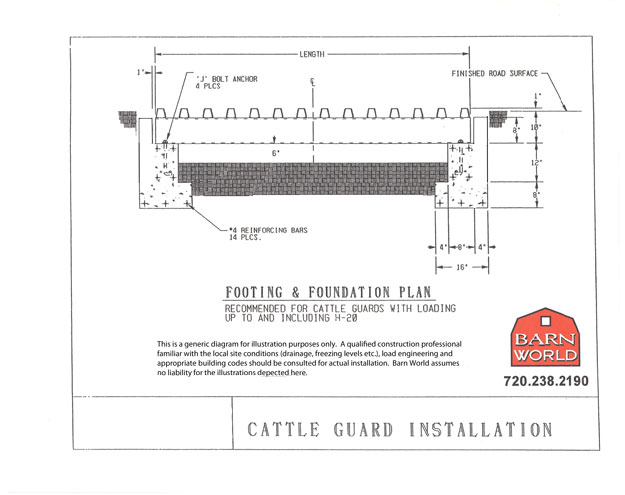
Generic Foundation Diagram

cattle guard foundation diagram

Excavation of the Vaulted Area

The vaulted, or dug-out area beneath the grid is key to providing the often overlooked optical barrier that dissuades livestock from even touching the top rails. Allowing the animal to view the bottom of the excavated area provides a conflicting depth perception created by the contrast with the top rail. This optical confusion (near and far at the same time) can be an effective visual deterrent all on its own.

Painted Guards

Studies have shown the illusion of a three-dimensional grate when painted across a roadway. and sometimes be effective at preventing crossing by itself. In the studies, cows were introduced to the fake barrier and almost all of them refused to cross initially. The trouble with the painted illusion was when one did eventually work up the courage to test the perceived barrier, it was able to walk over it without trouble. This then gave courage to the remaining livestock and they also soon followed.

The vaulted area is created by removing soil under the top rails to create a visual deterrent and allow debris to fall through. We typically recommend at least 6″ be dug below the bottom support beams as shown in the diagram. With a 12″ overall height, a depth of 18″ from the top rail to the bottom of the vault will be presented to the livestock. You may go deeper if desired, the important issue is that the foundations themselves are properly supported.

The vault also helps prevent debris from collecting between rails. If the vacant area beneath wasn’t there, dirt and debris would fill the area between the top rails, and the barrier would lose its effectiveness and become a livestock walkable bridge.

To help with drainage, the bottom of the vault should include a means of allowing water to drain away from the installation without disturbing the surrounding footings. Typically crushed gravel is used to create a french drain. Because every site is unique, a contractor familiar with the local conditions should be consulted.

Foundations

Concrete footings are usually poured on site but we do also offer precast concrete cattle guard foundations that can be shipped right along with our flat rail cattle guards.

cattle guard on top of concrete foundations

The concrete is designed to fit pre-drilled holes in the guard so they can be bolted down upon arrival. Quick, easy, and convenient, they’re becoming a more popular option for sites that don’t want to pour their own.

Surface Installation with a Boxed Cattle Guard

Boxed cattle guards are set directly on the ground and are designed for low traffic, remote and temporary installations. The box is a steel skirt welded to the perimeter to keep dirt from getting in underneath. Dirt is pushed up on either side of the guard to create a ramp for crossing vehicles.

Boxed Cattle Guard

a boxed cattle guard

This design is popular in remote areas like cell phone towers and oil wells. They’re also used at construction site entrances as rumble strips, washouts for cleaning equipment, and keeping the entrance clear of mud.

Although they lay directly on the ground, site preparation and proper drainage are a must. A bed of crushed gravel can go a long way to removing excess water and keep if from eroding your cattle crossing.

Site Specific

Foundations are critical to keeping your livestock barrier in place and working effectively. They secure the guard from moving and transfer the passing load to the ground. The above recommendations should be considered and a local contractor consulted for a long-lasting installation.

If you have any questions or would like help planning your project, please visit BarnWorld.com or contact us anytime and we’ll be happy to assist.

Facebooktwitteryoutube

Cattle Guard Synonyms

There are many names for what we, in the American West, call cattle guards. These effective livestock barriers are a simple series of parallel bars, made with either square or round top rails that are set in the ground across a road. They allow a vehicle tire to simply roll across the gaps created between the top rails while providing a physical deterrent for flat-hoofed animals.

Cattle Guard Installation

cattle guard with wings diagram
Sometimes, they’re ironically called cattle crossings but they’re actually anything but that. They’re designed to prevent livestock from crossing and not to provide a crossing for cattle!

In New Zealand, they are more appropriately called cattle stops and in the United Kingdom can be known as a cattle grid. Australians commonly refer to them as cattle grates and other names in the US include the Texas Gate, livestock guard, and cattle grill. As long as they keep your cattle from wandering away, any name will do.

Construction

Even though they’re called different names, they’re both available in steel and concrete. Steel is by far the most common material and they’re seen in use around the county. Concrete offers great flexibility for private use and can be much more economical than steel. They can also be highway-rated like steel.

Steel

The most common construction material is steel pipe. The pipe, also known as rails, is available in both flat and round rails. The top rails for the flat top guards are shaped like hexagons and create a flat surface for rolling tires. They’re good for high-speed traffic areas and give a smoother ride to crossing vehicles.

The round is a little more aggressive for livestock. and the concrete can be placed just about anywhere!

Concrete

Visit Barn World and see our large varieties of whatever you prefer to call them. We have the right configuration for private use as well as highway ratings from the AASHTO for your operation. We can help with any decisions you may be facing.

If you have any questions about them or would like a quote with delivery right to your project site, just let us know and we’ll be happy to help!

Barn World may be reached at Sales@BarnWorld.com and 720-238-2190.

Facebooktwitteryoutube

How is a Cattle Guard delivered?

Cattle guards can be one of the most useful time savers when crossing through a fence line. They don’t require you to stop and open a gate only to pull forward and do it all over again. You know how it goes, it’s most likely in deep snow and during a downpour! However, once installed, these long-lasting, set-and-forget livestock barriers can be the ultimate in convenience for you, your equipment, and your guests.

Below are some quick explanations of what to expect regarding the delivery and unloading process for these large cattle grids.

Concrete Foundations

cattle guard on concrete foundations

How is a cattle guard delivered?

Cattle guards are very large, one-piece steel structures that require a long, heavy-duty delivery vehicle. Typically a semi-truck is used which can raise some issues.

Entry and Exit

Due to their long trailer lengths, access to a large delivery and unloading area is necessary. This requires easy entry and exit from the site so the rig may pull through or use a large turn-around area to leave.

Unloading Equipment Requirements

The large weights involved also require that the receiver is able to provide a mechanical means of unloading upon arrival. The delivery vehicle and driver are unable to unload them from the truck so equipment must be present when the delivery is made.

From a shipping perspective, cattle guards are very large and extremely heavy., very heavy, and therefore expensive to ship. They are usually shipped by a freight company on a semi-truck. They can either be shipped inside a box trailer or on a flatbed trailer. If you include the wings, they must be shipped on a flatbed trailer. Consider buying a cattle guard with bolt-on wings as they can be shipped by either flatbed or box trailer and stack nicely. The bolt-on feature allows for more economical shipping are easy to install in the field.

Make sure you have the ability to unload the heavy cattle grid from the trailer when you arrange your delivery date as the freight trucks do not have any kind of un-loader.  You must have a forklift or front-end loader ready when it arrives.

Call Barn World with your cattle guard questions at 720-238-2190 or email Sales@BarnWorld.com today!

Facebooktwitteryoutube