Barn World Has HS20 Certified Cattle Guards for Public Roads
Barn World makes superior HS20-rated cattle guards for public roads and highways. Our HS20-rated cattle guards are made from schedule 40 steel and come in a variety of sizes to fit various cattle guard projects. We can alter the design of our cattle guards to use different kinds of pipe and rail depending on your needs. We have used round pipe, square rail, I-beam, and other types of rail and channel to make rated cattle guards that are suitable for all public crossings.
Barn World HS20-rated cattle guards conform to AASHTO load rating requirements by type of truck and maximum axle load. Our rated cattle guards come with an engineer’s stamp and are certified to meet the AASHTO load ratings so you can feel confident that you are getting the best quality cattle guard. Call Barn World with your questions and plans to get quotes on HS20-rated cattle guards at 720-238-2190.
Livestock Supplies
Cattle Guards for Public Roads require a Barn World HS20 Certified Cattle Guard
For superior HSHS20-certified cattle guards, visit www.BarnWorld.com. We offer the necessary cattle guard certifications and strong cattle guards made from schedule 40 steel. They come in a large variety of sizes to fit almost any project you may be involved in.
Used primarily for livestock control, they can offer a strong deterrent to deer if placed side-by-side to form 12a ‘ or more barriers to the direction of travel and other animals as well. Please note that we do not recommend cattle guards for horses, goats, or dogs as they simply are not effective. Horses can get a leg broken in them and goats, dogs, and other sure-footed animals will be able to cross the cattle guard.
Cattle guards can be made from different types of piping depending on our livestock control needs. We can use round 3-1/2″ or 4-1/2″ pipes or square pipes for the top rail. Typically the larger and more round the pipe that is used on top, the more of a deterrent it is for livestock. A 4-1/2″ pipe will have a greater curve and provide a more unstable footing for a daring animal. It will also have a larger gap between the pipes making it much more difficult to cross. The smaller 3-1/2″ pipe will still keep livestock off of your cattle guard and will provide a smoother rider for crossing vehicles. The same is true for the flat pipe. It will offer a very smooth ride when crossing but isn’t the strongest deterrent.
Every HSHS20-rated cattle guard is certified to conform to the load rating requirements provided by the American Association of State Highway Transportation Officials or AASHTO. They spell out the requirements and suitable load ratings for all highway-rated cattle guards. All of our rated cattle guards come with the engineer’s stamp to pressure at you’re installing an AAAASHTO-certified cattle guard.
For more information on cattle guards and cattle guard installation, please visit the informational website: www.cattle-guards.com or give us a call at (720) 238-2190 and we’ll be glad to help. Don’t forget, Barn World offers a large selection of livestock equipment and livestock supplies for all of your farm and ranch needs.
Barn World has a large offering of cattle guards for all different types of applications. Called by many names – Texas gates, cattle grids, animals guards and more, but they are an important part of livestock control and ease of use when crossing a fence-line.
Cattle guards fall into two basic groups: rated cattle guards and non-rated cattle guards.
Rated Cattle Guards
An HS20 and HS25 rated cattle guards are designed for highway use and certified to meet the specifications needed for State and Federal requirements such as DOT, BLM, USFS, NP, and US Military installations. They will provide years of rugged service in commercial applications such as mining, forestry, agriculture, and petroleum production. They are also the product of choice for residential usage where city, county, or state regulations require the HS20 rating.Certified structural steel is used in the manufacture of all Barn World’s HS-20 rated Cattle Guards.
Standard Cattle Guards
Barn World also carries a less expensive option for private use such as washouts and driveways. The Standard 6’and 8′ wide cattle guards are made of NEW 3″ Schedule 40 steel but do not carry the governments highway rating designation. All Flat Top Rail Cattle Guards may be ordered with optional wings, integral box, or removable box.
Made for easy installation. No need to dig a hole – simply cut your fence and lay the cattle guard on the ground.
Specifications:
1 1/2 x 11 gauge square tubing
72″ wide X 91″ long
Ramp is 14″ tall
Overall width of the guard including the wings is 87″
Comes standard with a grey enamel finish
Spec Cattle Guards
Our 7.5′ and 8′ spec cattle guards meet current AASHTO load ratings and are suitable for all types of applications where a square pipe is desired including heavy duty logging roads. They may be ordered with optional wings or clean-out line.
All cattle guards may be fitted with plow strips that allow plows to cross over the guard with minimal interference and wear.
All cattle guards may be outfitted with a removable box for easier cleaning as an option.
Barn World has a cattle guard to meet your needs. Please call us (720) 238-2190 with your questions and to obtain shipping quotes. We can also provide professional bid packages for large company, military, and government programs and carry a large selection for all of your livestock equipment needs.
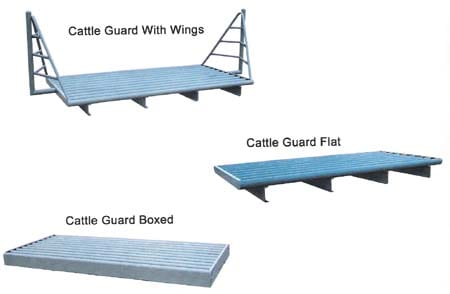
Choosing a cattle guard for your project doesn’t have to be overwhelming and we’re here to help. Here is a quick review of the subtle and not-so-subtle differences between cattle guard offerings. There are two common types of cattle guards: Boxed and Flat. Each has its’ own installation requirements as detailed in our installation post.
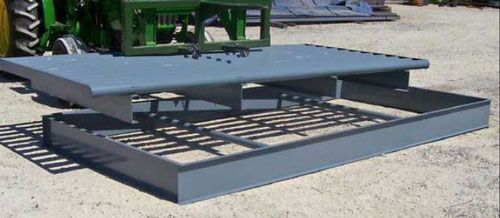
Boxed-style cattle guardsare built to lay on flat ground. A steel frame is welded all the way around the perimeter to prevent dirt and debris from migrating their way underneath. It is not to support the guard but is there just to keep the dirt out.
The boxed cattle guard will rest directly on its C-channel beams. To help with drainage, a gravel underlayment is recommended. These types of cattle guards are very popular with semi-temporary installations such as construction sites or limited access areas. They are also used as wheel wash-outs for trucks entering public roadways. They are designed to mount to a foundation over a vault and are used in permanent installations and public roadways.
Please read the post on installing flat cattle guards or visit our informational website www.Cattle-Guards.com for more information on the footing and foundation requirements. Flat cattle guards will rest entirely on the footings and pour a concrete foundation. The weight of the crossing traffic is transferred from the pipes to the structural beams, to the footings, and then to the ground. It is important that each footing is supporting the length of the beams for proper weight transfer.
Common points: Both flat and boxed cattle guards have the same strong values. The boxed merely has a steel skirt welded to it and rests on the ground rather than having permanent footings to rest on. Cattle guards are usually made with 4-1/2” OD pipe and will use 9 pieces to cross the beams or they may be built using 3-1/2” OD pipe and 11 total pieces. The spacing between the pipes is nearly 4” on average and the total height from the top of the pipe to the bottom of the support beams is nearly 12”.
The cattle guards usually come in gray enamel, but other colors are available on request. The most popular request is for safety yellow as it is sometimes required for government projects and construction sites. Flat cattle guards weigh approximately 100 lbs. / linear foot – so for example, a 10’ cattle guard will weigh about 1,000 pounds. If the guard is boxed, a good rule of thumb is to add 10 pounds per foot.
If wings are added as an option, estimate 100 lbs for each wing, or 200 lbs total.
Using Cattle Guard with other Animals
Deer:Cattle guards can be effective with other animals other than cattle. One of the most common requests is for deer. Unfortunately, deer are very athletic animals and are fantastic jumpers. An 8’ guard (in the direction of vehicle travel) will not stop or deter a deer from jumping it. The best arrangement to keep deer out is to set two 8’ cattle guards side-by-side to create a barrier of 16’ in the direction of travel. Cattle guards are easily bolted together.
Our experience has been that most deer will not venture over the guards that provide 16’ or more of ‘discouragement’. They are easily bolted together to provide extra distance in the direction of travel and a visual deterrent to jumping
Goats and horses: Although they are commonly used with horses, we do not recommend them for horses. They do provide the same effective barrier as with cattle, but because a horse hoof is more slender than a cow’s, they have the potential to slide between the 4” spacing of the top rails and become trapped. As a ‘flight animal’, they will struggle to get out and can unintendedly break their own leg in the attempt.
A cattle guard will almost always deter a horse, but on the off chance it decides to try and cross, it can expose it’s fragile leg to breaking during the struggle to escape. We do not want to see anyone’s animal put down because they got stuck in a cattle guard and would instead recommend a gate.
Goats on the other hand are very sure-footed animals that can walk right over a cattle guard without thinking twice. Dogs are also pretty adept at crossing.
Taking Delivery of a Cattle Guard
Please remember these very large items are very heavy. When they ship, they are usually on a boxed semi-truck or a flatbed trailer. The trucks cannot unload them at the point of delivery. It is therefore important for the customer to have equipment capable of unloading these large steel structures.
In some cases, it’s possible to drag the cattle guard out of the trailer, lower one end to the ground then the other. The unloading equipment does not necessarily have to be able to lift the entire guard all at once. It’s safer to lower one end to the ground so the rig does not come unstable and endanger anyone on the ground.
We hope this brief overview is helpful and if you have any questions at all, please let us know.
For more information on cattle guards, please call (720) 238-2190, email Sales@BarnWorld.com. or visit www.BarnWorld.com today!
There is a large variety of livestock equipment and cattle guards at Barn World and now we have cattle guards for ATV’s. When you’re out between pastures or along the fence line, nothing is more convenient that an ATV cattle guard.
Designed for easy installation, there’s no hole to dig, just cut your fence and lay the cattle guard on the ground. It’s that easy. The gentle rise in the texas gate is easy for a 4-wheeler to cross but keeps your livestock in. This is an easy and convenient piece of livestock equipment to install and use.
Cattle Guard for ATV
1- 1/2″ x 11 ga tubing square
14″ tall ramp
91″ long and 72″ wide
The width including the attached wings is 87″
Grey enamel finish
We have also customized these guards for use with rural golf carts and courses and it can be modified to accommodate almost any vehicle you need to cross a fence line.
Cattle Guards for ATV
Call Barn World today for more information or a shipping quote on this unique cattle guard and don’t forget that Barn World has a large selection of cattle guards for highways, construction use and private drives for you to choose from.
Barn World – more than just farm and ranch supplies and livestock equipment!
There are many types of Cattle Guards and several different methods of installing them that are dictated by traffic type and site conditions. Making sure your installation is appropriate for both will ensure a long lasting installation for years to come.
Below are a few of the more common methods and if you have any site-specific concerns, please contact Barn World and we’ll be happy to help.
Traditional Foundation Installation
Flat Cattle Guard Installation
Flat Top Rail Cattle Guard Installation and Foundation Requirements
Proper installation of a flat top rail cattle guard requires a sturdy foundation, including footings and a concrete vault. A permanent setup involves constructing a reinforced vault with 6-inch thick concrete walls around the perimeter. These walls serve a crucial role in keeping soil and debris from filling the area beneath the cattle guard, ensuring a clear and functional barrier for livestock containment. Additionally, strategically placed footings help distribute the weight of vehicles crossing the guard, preventing structural stress and premature wear.
Concrete Footers for Structural Support
Within the vault, concrete footers are poured to provide a stable resting surface for the support beams of the cattle guard. While specific requirements depend on local soil conditions, industry standards recommend that these footers be at least 12 inches wide and 18 inches deep. The footers must be positioned precisely beneath the support beams to properly distribute the weight of crossing vehicles, ensuring long-term durability. Consult a qualified contractor to assess your soil composition and determine the necessary reinforcements for your installation.
Optimal Vault Depth and Drainage Considerations
The recommended depth of the completed vault is approximately one foot. If the vault is too deep, livestock that attempt to cross may risk injury from falls. Since every cattle guard installation is unique, factors such as local soil composition and drainage conditions must be carefully considered. To facilitate natural drainage, most installations utilize crushed rock and porous soil at the base of the vault, creating a natural French drain effect. However, if the installation site has poor drainage, a PVC pipe system can be installed to channel excess water away and prevent water accumulation beneath the cattle guard.
Flat Rail Cattle Guards for Water Crossings
When installed correctly on a concrete foundation, flat top cattle guards can be placed over small streams or creeks, functioning similarly to a bridge. A culvert is often installed beneath the road surface, allowing water to pass through while maintaining structural integrity. The concrete footers are poured beneath the beams, embedding the culvert securely. A 6-inch thick retaining wall is then formed around the vault to prevent soil erosion and ensure stability. As traffic crosses the cattle guard, the load is transferred from the steel rails to the C-channel support beams, which then distribute the weight evenly onto the footers.
By following these essential installation steps, a flat top rail cattle guard can provide a durable, low-maintenance livestock barrier that supports both heavy traffic and effective containment. Whether used on ranches, farms, or commercial properties, proper foundation planning is key to ensuring longevity and optimal performance.
Boxed Cattle Guard Installation
Boxed Cattle Guard Installation and Best Use Cases
The most straightforward cattle guard installation method utilizes a boxed cattle guard. Unlike traditional flat rail designs, these guards are designed to sit directly on the ground without requiring footings or a concrete vault. The welded steel box attached to the guard serves a single purpose—to prevent soil from filling in underneath, maintaining a clear barrier for livestock containment.
Surface Preparation and Installation Considerations
For optimal performance, the installation surface should be as level as possible. This minimizes movement and ensures a stable crossing for vehicles and equipment. While boxed cattle guards do not require permanent anchoring, they may be temporarily secured to prevent shifting, especially in high-traffic areas. They perform best on firm, compacted soil, where they can be set in place and covered with dirt ramps on either side to create a smooth transition for crossing vehicles.
Enhanced Stability with Railroad Ties
One effective method to improve long-term stability and prevent sinking is placing the cattle guard on a set of railroad ties. This approach helps distribute the weight of passing vehicles, reducing pressure on soft ground. If there is concern about slippage, especially on sloped surfaces, the cattle guard can be securely bolted to the railroad ties for additional reinforcement.
Best Applications for Boxed Cattle Guards
Boxed cattle guards are commonly used in temporary or semi-permanent installations where ease of relocation is a priority. Some of the most popular applications include:
Construction sites – Keeping livestock out of active work zones
Oil and gas drilling sites – Preventing livestock intrusion
Truck wash stations – Preventing debris from being tracked onto public roads
Maintenance and Relocation
Since boxed cattle guards are fully portable, maintenance is simple. Over time, debris may accumulate underneath, reducing their effectiveness. To clean, the guard can be dragged a short distance, allowing dirt and debris to be cleared before repositioning it back in place.
Strength and Durability
A boxed cattle guard provides the same level of strength and durability as a permanent flat rail cattle guard. However, its key advantage is its ability to be moved from one job site to another without the need for excavation or concrete work. This makes it an ideal solution for businesses and landowners needing a reliable yet flexible livestock barrier.
For those seeking a temporary yet highly effective cattle guard solution, boxed cattle guards offer a practical, durable, and easy-to-install option suited for a variety of commercial and agricultural applications.
Removeable cattle guard
There is also a handy option for the integral box design called the removable box option. In this unique setup, the steel skirt is a standalone box and the cattle guard may be removed from it without disturbing the surrounding installation site. This is very useful for cleaning out debris in the vault beneath the cattle guard without having to reinstall the guard itself.
The box does not provide structural support or carry any weight, it is merely there to keep dirt from filling in below the category. The flexibility to remove the guard itself is the purpose of the design.
For more information on cattle guards, please call (720) 238-2190 or visit Barn World online at www.BarnWorld.com.
Barn World now carries a ‘basic class’ of cattle guard for private farm and ranch use. They provide the same strength and longevity as an American Association of State Highway Transportation Officials (AASHTO) rated guard, but without the cost.
The basic class was designed with the private drive and rancher in mind. Allowing for easy access to your property while eliminating the need for gates, these cattle guards give open access to your land and keep the livestock where they belong. It’s built from heavy duty structural .188 (3/16″) walled pipe with a diameter of 3.5″ or 4.5″ depending on availability or request. Note that the walls of the basic guards are thicker then schedule 40 ensuring years of durability and strength.
These cattle grids or are capped on the end to prevent any rusting and are also offered with wings, flat or boxed if so desired. There is no difference in strength between the boxed cattle guard and the flat cattle guards.
All of our cattle guards weigh about 100 lbs. per foot (a 10′ cattle guard weighs about 1,000 Lbs.) and when boxed, add approximately 8 lbs. per foot for boxed cattle guards. Cattle guard wings add approximately 200 lbs. total.
For use with deer, it will be necessary to increase the distance in the direction of travel. Deer are terrific jumpers and will be able to leap an 8′ cattle guard without any trouble. In that case, you may need to place two cattle guards in tandem so you have 16 feet of protection. Cattle guards are easily bolted together and can provide an effective deterrent for deer.
If you have any questions about cattle guards, please call (720) 238-2190 or visit us at BarnWorld.com. Please consider Barn World for all your livestock equipment needs.
When choosing a cattle guard it’s important to make sure it’s the correct design, style and has the proper load-carrying needs for your vehicles. Installation process is also another important consideration detailed some basic helpful suggestions below.
Load Ratings
One of the most important design characteristics to consider is the load carrying of the crossing. Public roadway is require a 16 ton per axle rating while a private driveway most likely don’t need that extra capacity.
For that reason, we offer a more economical, round top rail cattle guard design for use on ranches and private driveways. The estimated load carrying capacity is 12 tons per axle which easily accommodates fully loaded semi’s and most farm and ranch equipment.
Cattle Guard Load Ratings H-15 (12 tons per axle) H-20 (16 tons per axle) U-54 (25 tons per axle) U-80 (30 tons per axle)
If you have a remote, or private-use entry and exit access needs, these round top rail designs are a much more economical option and can save a lot of money over the engineered stamped and rated cattle guards used in public roadway project.
Cattle Guard Box Options
One unique design that continues the burden of installation is the addition of a box to the guard. The boxed allows the guard to be set directly on the ground without the need for a foundation. Although we do recommend they be set on the road ties or some other substantial support, a vaulted area with concrete foundations is not always required.
The box is available as a fixed or removable option.
Fixed Boxed Cattle Guards
The fixed box option is the steel skirt welded to the perimeter of the cattle grid. This simple addition dirt from creeping in underneath the top rails one installed directly on the ground. It is very useful for remote and low traffic areas as it can simply be set in place. The box will add about 7″ to the overall length and width of the cattle guard.
To assistant vehicles crossing, the guard can be slightly buried in the ground or dirt be piled up on either side to create a ramp for ease of access.
Removable Boxed Cattle Guards
The removable box allows the guard to be lifted out of the installation without disturbing the surrounding environment. This is especially useful when cleaning underneath the top rails to keep the vaulted area below clear of debris.
This handy feature is available for all round top rail guards and is a fantastic option that allows for easy cleaning.
ATV Cattle Guard
For those of you looking for a simple and effective access for smaller ranch vehicles between pastures, is designed is built for ATV’s.
This unique structure is incredibly useful for inspecting fence lines and allowing an ATV to cross through them. Installation couldn’t be easier! It’s a single, one-piece unit that is literally set in place and tied to your fencing.
We do recommend proper drainage at the site as well as keeping the vegetation growth from growing through the top rails and hiding the crossing from your animals.
Let us know if we can help!
Keeping your livestock contained while providing effortless access to your vehicles is what cattle guards are designed for. Make sure you select proper barrier and you’ll have years of gate free access while your animals are safely secured.
For information, please visit www.barnworld.com, or give us a call at (720) 238-2190 and we’ll be happy to help!.
Barn World has a large selection of cattle guards for all of your livestock guard needs. They may be called by various names (Texas gates, animal guards, cattle grids, cow guards etc.) but they all are the same great idea. Barn World has a cattle guard for every need.
Visit Cattle-Guards.com for a great informational cattle guard website.
An HS20 and HS25 rated cattle guards are designed for highway use and certifedto meet the specifications needed for State and Federal requirements such as DOT, BLM, USFS, NP, and US Military installations. They will provide years of rugged service in commercial applications such as mining, forestry, agriculture, and petroleum production. They are also the product of choice for residential usage where city, county, or state regulations require theHS20 rating.Certified structural steel is used in the manufacture of all Barnworld HS20 rated Cattle Guards.
Barn World also carries a less expensive option for private use such as washouts and driveways. The Standard 6’and 8′ wide cattle guards are made of NEW 3″ Schedule 40 steel. All Flat Cattle Guardsmay be ordered with optional wings, integral box, or removable box.
The ATV cattle guards are unique in the industry. These cattle guards are suitable for all types of projects on private land. The standard boxed cattle guards are perfectly suited to construction sites, mine sites and oil field applications.
Our 7.5′ and 8′ spec cattle guards meet current AASHTO load ratings and are suitable for all types of applications where a square pipe is desired including heavy duty logging roads. They may be ordered with optional wings or cleanout line.
All cattle guards may be fitted with plow strips that allow plows to cross over the guard with minimal interference and wear.
All cattle guards may be outfitted with a removable box for easier cleaning as an option.
Barn World has a cattle guardto meet your needs. Please call us (720) 238-2190 with your questions and to obtain shipping quotes. We can also provide professional bid packages for large company, military, and government programs and carry a large selection for all of your livestock equipment needs.
There are many different choices when selecting a cattle guard for your livestock containment needs. They may be called by various names (Texas gates, animal guards, cattle grids, cow guards etc.) but they all are built around the same great idea: provide a visual deterrent coupled with a physical barrier to keep livestock from crossing. This provides containment for your herd while allowing vehicle crossings without a gate!
The rated cattle guards are designed for highway use and certified to meet the specifications needed for State and Federal requirements such as DOT installations. They’re design and construction is certified by an engineer to meet the required load ratings.
Cattle Guard Load Ratings
H-15 (12 tons per axle)
H-20 (16 tons per axle)
U-54 (25 tons per axle)
U-80 (30 tons per axle)
The rated cattle guards are designed for highway use and certified to meet the specifications needed for State and Federal requirements such as DOT installations. They’re design and construction is certified by an engineer to meet the required load ratings.
They’re available in flat top rail designs in a powder-coated finish as well as the more economical round top rail design that’s coated in a tough enamel. They will provide years of rugged service in heavy-duty high traffic public areas.
These are also available for private driveways such as farms and ranch applications. This design in much more economical and we estimate the load-carry capacity at 12 tons per axle. That’s plenty for most driveway use and easily support fully-loaded semis. We call them ‘Standard Cattle Guards.’
Barn World’s private-use, economical choice of the standard guard is a very popular option for driveways. They are made with NEW 3″ Schedule 40 steel with the same construction technique used on the rated guards.
All of the round top rail designs may be ordered with optional wings, integral box, or removable box.
are unique in the industry. They’re built for quick and easy installation and attach directly to your fence line without the need for a foundation. We recommend providing sufficient drainage to the area and keeping it clear of overgrowth from surrounding vegetation. Other than that, simply set in your fence line, attach the fencing to the uprights and you’re done!
Options
All cattle guards may be fitted with plow strips that allow plows to cross over the guard with minimal interference and wear.
All round top rail designs may be outfitted with a removable box for easier cleaning as an option.
They may also have a steel skirt welded to the perimeter which allows it to be placed directly on the ground without the need for a foundation.
Barn World has a cattle guard to meet your needs. Please call us (720) 238-2190 with your questions and to obtain shipping quotes. We can also provide professional bid packages for large company, military, and government programs and carry a large selection for all of your livestock equipment needs.
Barn World carries many different types of cattle guards in design and load-ratings. There is a design for almost any type of project, from residential driveways, highway projects and even for heavier-than-public roadway projects.
Load Ratings
The engineered load-carrying ability of the guards are certified on a ton-per-axle standard; that is, how much weight is on each axle . These engineering standards are set by the AASHTO or American Association of State Highway and Transportation Officials show below:
Rated Cattle Guards
Cattle Guard Load Ratings
H-15 (12 tons per axle)
H-20 (16 tons per axle)
U-54 (25 tons per axle)
U-80 (30 tons per axle)
The minimum requirement for public highway projects is the 16 ton per axle rating but as you can see, they can be designed to hold almost double that if needed!
We are usually involved with highway projects and the H-20 rating is the most popular and in high demand however, we get a lot of calls for cattle guard installation for use on private property that don’t require such a high engineered load rating.
Private Use Cattle Guards
We have a design for private use in the round top rail guards for driveways and farm and ranch traffic that can accommodate fully loaded semis. Although they’re not certified by an engineer’s stamp, we estimate they hold 12 tons per axle which is the same as the flat top rail H-15 load rating.
The best part of this residential design is that it’s much more affordable while still meeting the typical driveway traffic needs of the common farm and ranch.
All of the Standard Guards are made from NEW Schedule 40 steel. All ends of the top rail pipe are capped to prevent rust. Bolt-on wings and boxed cattle guards are available with all sizes and are finished in gray enamel.
Types of Cattle Guards
Although they’re all effective physical livestock barriers, there are some options available for the best fit for your needs. Wings, boxes and the size of pipe should all be considered before selecting what’s right for your use.
BOXED CATTLE GUARDS LIE DIRECTLY ON THE GROUND
This style is designed to sit directly on the ground without concrete footings and it’s an available option on all the round rail designs. What we’ve done is welded a steel skirt to the perimeter to keep dirt from creeping in underneath. This also allows you to make a dirt ramp on either side to help vehicles cross without it running underneath. The weight of crossing vehicles is transferred from the top rails to the c-channels below and then directly to the ground. Unlike a traditional installation, the weight is directed through the full length of the channels rather than just on the ends.
The fixed box design is popular in low traffic or remote areas like cell towers, farms and ranches as well as temporary sites. In fact a lot of construction companies use them as wash bays or rumble strips for equipment leaving a site. They can also pick them up when done and move on to the next job.
The removable box option makes it convenient to remove the guard without disturbing the surrounding installation area. The boxed section does not carry any of the load, it’s a separate and individual frame the guard sits in and provides no structural support at all.
Fixed Boxed Option
Removable Box Option
Because they do rest directly on the ground, a few precautions should be noted. A flat ground area is a must as any kind of slope will allow it to ‘walk’ or travel downhill. A lot of customer will bury railroad ties to anchor them and help prevent walking. The issue is drainage. We’d of course recommend a local contractor familiar with the site conditions be consulted and would suggest a bed of crushed gravel be used as well. This will help drain water away from your crossing and preserve the installation area.
The traditional installation calls for a concrete foundation to anchor to and transfer weight to the ground. A ‘flat’ style design is mounted to a poured-cement footing in the ground and bolted directly to prevent movement. This permanent installation allows for heavy-duty and high-traffic crossing without concerns of movement or settling. We usually see the rated cattle guards used for these public highway construction projects that require the load ratings that private use designs don’t call for.
Below is a generic foundation diagram for reference. Please note that every site is different and a qualified professional should be used to ensure a proper, long-lasting installation.
Cattle Guard Foundation Diagram
CATTLE GUARD WINGS
This is an essential option to prevent your cows from simply walking around your barrier. The wings allow you to tie the fencing directly to the guard so they can’t step around the connection. If a single fence post is planted next to the middle of the grid, livestock are able to bend around the post and walk next to the side of the steel and go on their merry way!
As you can see from the picture above, the wing takes the vertical structure of the fence and spreads it horizontally to the bottom of the grid. This effectively creates a ‘horizontal fence’ so your animals can’t walk around the guard.
CATTLE GUARD FOR DEER
A note on using these barriers for deer. Believe it or not, deer are much better jumpers than cows! Depending on the type of deer in your area, they can easily clear a 12′ long jump and won’t even think about flying over. We suggest at least 16′ in the direction of vehicle travel to discourage jumpers.
To get that kind of ‘depth’, we can lay two sections next to each other and bolt them together. We can pre-drill holes upon request so you can just connect them in the field when they’re delivered. Just remember to check that your fencing is tall enough to keep them out as well!
BUYING A CATTLE GUARD
We’re happy to help help select the proper crossing for your needs. We can forward a quote with shipping directly to your site. Feel free to give us a call anytime at (720) 238-2190 or email Sales@BarnWorld.com. See our entire cattle guard selection here and send us an email and we’ll reply with a quote with shipping for your consideration!