Now is the time to invest in a quality hay feeder, hay prices due to rise

Hay prices are due to rise and now’s the time to get a quality hay feeder to minimize waste.  With prices expected to climb as the year goes on, it’s more important than ever to eliminate wasted hay and not throw money away when feeding your livestock.

Barn World has a large selection of hay feeders. From new designs that literally eliminate waste like the round bale feeder hay hopper for cattle and the round bale feeder hay hopper for sheep and goats.

For cattle

For sheep and goats

Their designs allow the hay be suspended above the ground and contain any falling hay so it may be accessed by your livestock without being trampled and wasted.  These feeders will literally pay for themselves in a short amount of time.

Barn World also carries a wide selection of traditional round bale feeders.  Closed bottom hay feeders offer a simple and economical way to keep the hay from blowing around and from being pawed at and turned into wasted hay/money.  We also have the Bull Tuff hay feeder designed to take any abuse livestock can throw at it.  It’s one of the heaviest duty hay feeders on the market and is designed for maximum durability.

Bull Tuff Feeder

For horses, please check out the poly horse hay feeders designed especially for equine.  All hardware is counter sunk so nothing is exposed, providing protection and safety for your horse.  These feeders are lightweight and made of durable yet extremely strong plastic and are easy to manage.  The round bale feeder is 7 ‘ in diameter and the square panel feeder can be made into almost any size desired.

For longhorn cattle, we offer the modified round bale feeder with metal plates welded to the uprights to prevent horn-hook.

All of these feeders are designed to prevent wasted money through wasted hay when feeding your livestock.  Nothing is more disheartening then seeing your hay scattered around the pastor being walked on instead of eaten.  With the price of hay continually rising it is important to contain your costs with a hay feeder from Barn World.

Please see our full selection at www.BarnWorld.com and view all of our products from cattle guards to saddle pads.

Here’s an article from The Northwest Farm Credit Services newsletter, July 2011 detailing the outlook for the cost of hay for the remainder of the year.  Between a limited supply in an increase in demand, costs are expected to rise.

Hay supplies tight in the Pacific NorthwestPDFPrintE-mail
Wednesday, 13 July 2011 10:52
Hay supplies in the Pacific Northwest are tight. The 2011 season began with very little carryover hay available, and the cool, wet spring significantly delayed first cutting.Although the region is now moving toward second cutting, hay yields and quality have been impacted by adverse weather. With the supply situation little improved, strong demand for new crop hay is driving prices toward levels not seen since 2008.

In the Columbia Basin, harvest timelines are running between two and three weeks later than usual. First cutting of alfalfa in the Southern Basin began the last week in May and ended mid-June. Early first cutting was rained on heavily, and damaged hay was either sold directly to area dairies or green chopped.

It’s expected that all of the first cutting in the Southern Basin received at least some rain. Growers in the Northern Columbia Basin completed first cutting during the second to last week of June. It is estimated that between 75 and 80 percent of the alfalfa in the Northern Basin was rained on. Overall, yields were average to above average, but quality was off due to rain damage.

At the end of June, prices for new crop alfalfa in the Columbia Basin were running as high as $260 per ton at the stack for supreme quality. Prices for premium alfalfa were between $225 and $235, and between $215 and $225 per ton for good quality at the stack. In some cases, even fair-quality alfalfa traded above $200 per ton and lower-quality, rain-damaged hay sold for $150 per ton.

Second cutting in the Southern Basin began the last week in June and harvest will be in full swing by the first week of July. As the weather warms, there is some thought that the season will improve. Although growers north of I-90 advise they’ll be limited to three cuttings, hay producers in Othello and Mattawa have indicated the possibility of four.

The market for timothy hay was strong last year, and growers are expecting another year of profitable prices. Most growers in the Columbia Basin completed first cutting timothy during the last week of June, and Kittitas Valley producers should be mostly wrapped-up with first cutting the first week in July.

Interest in timothy is reportedly picking up, with prices mainly between $240 and $265 depending on quality. USDA Market News reported the sale of 600 tons of premium quality timothy at $280 per ton for export.

In Idaho, first cutting of alfalfa was delayed two to three weeks, and rain and cool weather continue to hamper the crop. Any hay cut prior to June 10 was rained on heavily. Second cutting will begin the last week in June. Due to the delay, predictions are that the area is likely to lose one cutting this year, and overall yield will be down 1.5 tons.

Alfalfa is in high demand from dairies, and at the end of June first-cutting supreme-quality alfalfa was selling between $220 and $240 per ton at the stack. Although prices for supreme-quality hay had reached upwards of $260 per ton for early first cutting, dairies are mainly resisting prices above $250 per ton despite limited supplies.

Premium hay had been selling between $225 and $235 per ton, and good hay for near $210 per ton. Low-quality rain-damaged hay sold for $145 per ton. For perspective, premium-quality hay sold for $150 per ton in December 2010.

Harvest timelines are running a week to two weeks behind in Oregon’s Klamath Basin. As of the last week in June, first cutting was between 75 and 85 percent complete. Yields were reported below average, and the area experienced some fairly significant rain on June 28.

A number of growers had not yet begun their first cutting, but planned to be in the field by July 1. (The cool weather allowed these growers to avoid the rain without the crop becoming over mature.) Prices in the region’s hay market were just being established, but USDA Market News confirmed the sale of 400 tons of supreme alfalfa for $250 per ton at the stack at the end of June.

Anecdotally, premium-quality hay had been priced in the $220 to $230 per ton range, and feeder hay between $190 and $200. The Klamath Basin is seeing strong demand from both in- and out-of-state buyers looking to secure inventories.

Primarily the market for first-cutting alfalfa is being driven by dairy demand. With hay acres down across the Northwest and expected lower yields on this year’s crop, dairymen don’t expect prices to soften much during the year. Because many dairies have been forced to buy hay hand-to-mouth, the supply gap between the end winter and first cutting 2011 meant that some dairies were almost out of hay.

At this point, higher milk prices are allowing dairies to cash-flow higher hay prices, and dairies that are desperate for hay are willing to buy at nearly any level of quality to lock up needed supplies.

Generally, exporters are taking a cautious approach to the market, not wanting a repeat of 2008 when prices got so high buyers backed-off. Many exporters were forced to write down high-priced hay inventories when the hay market crashed. Although exporters are anxious about procuring needed supplies, the price of first cutting is too costly given the low quality.

Instead exporters are focused on second cutting, which they hope will be of higher quality. A risk, though, is that if prices remain high and the Northwest is unable to produce a consistent supply of high-quality hay, export customers may turn to other markets for hay.

Good news for Northwest exporters is that the market is strong. According to the most recent data available from the U.S. Department of Commerce, Northwest hay exports rebounded strongly between December 2010 and March 2011.

Last summer began a trend where California hay exports exceeded those of the Northwest (for the first time ever). Referencing the graph below, hay exports from the Northwest in March were up 26 percent from February, and 35 percent year-over-year.

071311_hayprices

Exports to Japan from the Northwest were up 19 percent year-over-year in March and exports to other countries were up 58 percent. With respect to Japan, concerns over the impact of the tsunami on Northwest hay exports, so far, have proved unfounded.

Japan remains in the market for hay. Recognizing the tight supply situation this year, Japanese buyers have been fairly aggressive in negotiating for hay. Another positive factor is that China’s domestic supply of hay is down this year.

Overall, prices in Northwest alfalfa market are expected to maintain traction due to lower yields and fewer acres in production in 2011. Northwest dairies and exporters will compete heavily for second cutting, and California dairies and exporters are likely to enter the market searching for additional supplies of hay.

The significant hay shortage on the West Coast will likely find only limited relief as additionally new crop alfalfa becomes available. The reality is that supplies are tight, and weather for the remainder of the season will ultimately dictate how short the crop really is.  FG

—Source: Northwest Farm Credit Services newsletter, July 2011

Graphic courtesy of Northwest Farm Credit Service
Graphic sources: U.S. Department of Commerce, Hoyt Report, and USDA National Agricultural Statistics Service (Northwest average alfalfa price includes Idaho, Oregon and Washington)

Facebooktwitteryoutube

Hay Feeder: Hauling hay with a school bus – ingenuity at work!

Check out this neat article from Progressive Forage Grower that shows the ingenuity of a farmer in Kansas complete with a video of his hay hauling technique.
Although Barn World doesn’t offer hay haulers like the school bus below, we do have a large selection of hay feeders and other livestock equipment and livestock supplies for your farm and ranch.  Be sure to check out Barn World for everything from saddle pads to cattle guards, to hay feeders.


Written by Alisa Anderson

Updated June 23, 2011

Instead of hauling one or two bales at a time with his tractor, David Anderson used his brain to save time.He converted a school bus into a bale hauler.

Anderson has two bale haulers – a round bale hauler and a square bale hauler. The square bale hauler can pick up and haul 12 three-by-three bales, or eight four-by-four bales, and the round bale hauler can pick up and haul seven to eight round bales.

Two hydraulic arms squeeze the sides of the bale and lift the bale to the “table” on top of the bus cab. The table lifts up at an angle, and the bales slide down to the back of the bed, which is set up at an angle. When you are ready to unload, the forks at the end of the bed drop down, and as you drive away the bales slide off.

“I can mount the hauler on any type of vehicle; you just have to change the angle of the bed and the points of your lift arms,” says Anderson.

Anderson purchased an old school bus from a school district to mount the bale hauler on. The bus has an automatic transmission so the driver won’t wear out the clutch, has a diesel engine, drives faster than a tractor and uses farm-grade diesel.

Used school buses usually don’t cost more than $4,000 and have been kept in excellent condition. Anderson paid $2,000 for his first bus. He says if you use flotation tires, they won’t compact the soil, but Anderson just uses the tires that were on the bus. The flat surface on top of the cab gives the hay hauler good stability, even on a hillside.

Anderson bought a 28-horsepower Kubota engine to independently drive his hydraulics. It uses the same electrical system, generator and fuel tank on the bus, and only uses about a gallon an hour. He installed an electric clutch pump that uses a fan belt to drive the hydraulics. It’s slower than an engine- mounted pump, but also much cheaper.

“I used electric instead of hydraulic so I wouldn’t have to run all the hoses into the cab,” says Anderson.

Anderson is working to build a kit that can be sold at local dealers. Farmers could then buy their own vehicles and mount the hauler on them.

“It’s so time-consuming to just pick up only one or two bales, and drive back and forth and back and forth over the field. This way it just saves time. There are comparable machines on the market, but they’re very expensive,” says Anderson.  FG

For more information and photos e-mail Dsonhay@aol.com

The video was featured in the June 16, 2011 issue of The Jewell County Record and The Superior Express newspapers)

Facebooktwitteryoutube

Hay Hopper Hay Feeder from Barn World – a hay feedeer designed to minimize waste and maximize profits!

The Hay Hopper Hay Feeder

hay feeder – hay feeder hopper

Here’s a great video demonstrating the cost savings of our hay hopper hay feeder at Barn World.  This great design minimizes hay feeder waste and maximizes your profits.  The hay feeder ships as 2 pieces and ships competitively throughout the United States.  Call us today for shipping quote and start saving money immediately and take a look at all of our hay feeders that we have to offer.   Don’t forget Barn World is more than just livestock supplies, we also carry everything from cattle guards to saddle pads to feed bins.  Visit Barn World.com today or call 720.238.2190  for all your farm and ranch supplies.

Sorry, but the phone number listed in the video is no longer accurate.  Please call 720.238.2190

Video Text:
If you’re looking for a heavy-duty hay feeder that will pay for itself, then you’ve come to the right place.  Our hay hopper feeder will help eliminate waste.  If you’re currently using a standard a feeder, you could be losing 10% of your hay.  If your hay is $100 per ton, and you feed 2000 pounds per day, you’re losing $10 per day, $300 per month or $3600 per year.

Though continue to throw away your hard-earned money, purchase a hay hopper feeder from the Barn World Farm & Ranch Superstore, you can put more of your money in your pocket at the end of the year.  Our hay hopper feeder comes with or without steel around the bottom.  Just let us know what you want by giving us a call at 720-238-2190 and start saving your money.

Our two-piece design makes shipping affordable anywhere in the US.

Facebooktwitteryoutube

Hay Feeder Review from Barn World – here’s an awesome portable go anywhere feeder!

BarnWorld.com

Health-EZ hay feeder review from Barn World

portable stall feeder for horses

The portable stall feeder is a simple, rugged and easy to use hay feeder.  It’s extremely durable, lightweight and a breeze to use. No more messing with stuffing a hay net!

Of all the hay feeders we offer, the Health EZ is the most versatile. It’s great traveling to shows as it hangs in the trailer and just about anywhere where can clip to.  Whether in the trailer or after arriving at a show, keep your animal busy and feed with this ‘go-anywhere’ flake feeder.

horse eating from portable stall hay feeder

It was recently voted Tack’ N Togs best new product for 2010!!

“The innovative Health E-Z Hay Feeder, a portable feeding solution, can be hung low for natural “heads-down” grazing position, improving respiratory health and reducing incidence of sand colic. Slows down consumption and keeps hay off the ground and out of bedding or manure. Safe for all sizes of horses.”

Here are some of the great features of the hay feeder:

  • Can be hung low to the ground to encourage natural equine eating habits that improve your horse’s respiratory system.
  • The rounded edges of the Health EZ Hay Feeder are safety-oriented. No more rope burns!
  • The oval openings are designed with the horse’s muzzle in mind – smooth and just wide enough to fit the nose through.
  • Easy to fill while still hanging on the wall of the stall or trailer.
  • Handles allow the Health EZ Hay Feeder to be carried and hung most anywhere: in a stall, on a trailer, on the corral fence or paddock.
  • Comes with 3/8″ rope and snap for easy use and hanging.
  • Slows down consumption time for better digestion, replicating Nature’s way of slow grazing.
  • Keeps your horse preoccupied with getting the hay out, resulting in less boredom.
  • With openings on all sides, your horse can always reach the hay, no matter how he turns it.
  • Stall cleaning is easier and faster with less hay to pick up and throw away. Less mixing of hay and bedding!
  • The functional design catches smaller pieces of hay in the bottom instead of falling to the ground, resulting in less waste and loss.
  • The Health EZ Hay Feeder is an ideal hay feeder for all your grazing animals, including goats, cattle and sheep

Call Barn World today or visit our site: www.BarnWorld.com and try this new hay feeder.  Remember, Barn World has more then equine supplies, we carry a full line of farm and ranch equipment and everything from saddle pads to cattle guards too!

Facebooktwitteryoutube

Saddle Pad Construction Video from 5 Star – a Barn World favorite!

Saddle Pad Post from Barn World

BarnWorld.com

Barn World

Here’s a great saddle pad overview presented by one of the owners of 5 Star on why these saddle pads provide such high performance and wicking ability:

Transcript:

In the last 20 years the industry has come up with using every conceivable kind of thing out of the auto industry and space industry that was never intended for use in horses.  Everything from gels to foams to freezer linings all of these have zero or next to nothing as far as good quality and compression protection and absolutely zero in wicking ability and the agents that are needed for wicking sweat and heat away from the horses back.  Pressed industrial felt is the only thing that has really been proven over time to have the high quality wicking ability and high compression ratio for horses. 5 Star has 3 times the compression ratio of any other pad on the market and has 2 times the wicking ability of any close competitor in the felt industry as far as pads are concerned.
So why is 5 Star so good?  5 Star uses the highest quality virgin wool content in their felt.  Only through the use of high-quality virgin wool, can you have a high-quality compression ratios and the high wicking quality you can get.  Add to that,5 Stars established French curve that will fit any horse backline that settles in to create high-quality performance.  5 Star is a pad that will last forever, kind of like an old sweater that you snag and you throw away so that you have a chance to get a new one.  Nothing makes it simpler for performance and making 5 Star the best pad in your tack room.

Remember to visit Barn World for all of your saddle pad and equestrian supply needs.  We carry a full line of cinches, breast collars and even sheepskin pads for all of your riding fund.

Facebooktwitteryoutube

Saddle Pads from Barn World

BarnWorld.com


5 Star saddle pads from Barn World

Barn World carries the highest quality saddle pads available.  All of the equine pads we offered are one-hundred percent wool and are uniquely designed to ensure they provide the best in saddle pad performance and comfort for both you and your equine partner.
Check out this video from the owner of 5 Star detailing how much quality goes into a 5 Star saddle pad and why it is so much better than the competition’s and remember to visit www.BarnWorld.com for all your livestock supply needs.

From the video:
A lot of gimmicks can be strapped under a saddle to get one benefit or another, but man has yet to create a product that outperforms virgin wool, and over the long haul, virgin wool content felt pads will outperform any other type of pad or blanket hands down.  5 stars 100% percent wool contoured saddle pads conform immediately to your horse’s back for perfect fit.  Our F-11 wool felt has the highest virgin wool content available and offers 3 times more compression protection and wicking ability than any other pad on the market.
While the importance of compression protection is pretty clear given the dominance of rubber, bubble wrap and space age jelly saddle pads today, only high quality wool felt offers great compression protection while simultaneously wicking away moisture.  That wicking action is the means by which heat is dissipated under the pressure of the saddle.  The best compression protection, coupled with the best wicking ability, translates to the best performance from your equine partner.
When you consider the amount of money one might spend on feed, tack, vet bills and entry fees to pursue your equine passion, a saddle pad with all the ingredients for maximum performance is essential.
While the big ships full of cheap goods leave a toxic trail all the way from Los Angeles to China and back, 5 Star is producing the highest quality products right here in the USA.

Facebooktwitteryoutube

Cattle Guards for Public Roads – the HS20 Cattle Guard from Barn World

Barn World makes superior HS20-rated cattle guards for public roads and highways. Our HS20-rated cattle guards are made from schedule 40 steel and come in a variety of sizes to fit various cattle guard projects. We can alter the design of our cattle guards to use different kinds of pipe and rail depending on your needs. We have used round pipe, square rail, I-beam, and other types of rail and channel to make rated cattle guards that are suitable for all public crossings.

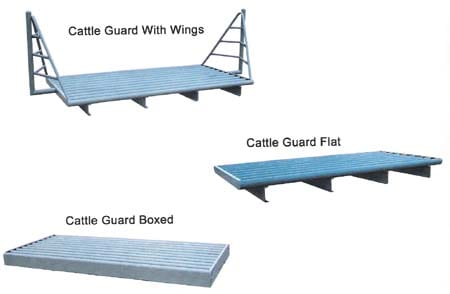
Cattle Guard Designs

cattle guard styles

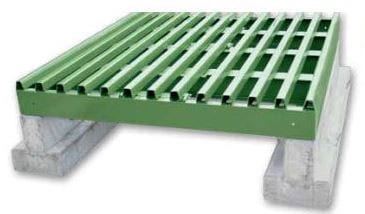
cattle-guard on concrete foundations

The Round Top Rail Cattle Guard offers the most aggressive livestock deterrent as the exposed surface area the cattle will be trying to balance its flat hoof on is entirely curved. They’re very popular for use on private driveways and areas where vehicle traffic is usually at lower speeds.  It does create a bit of a rougher ride for crossing vehicles when compared to the flat-top rail design.

Flat Top Rail Cattle Guards are very effective and popular and like the round rails, they are very good at keeping flat-hooved animals from crossing.  The flat tops offer a smoother crossing for high-speed traffic and are commonly used by the forest service and other government entities for large-scale installations.

Both the flat and round top rail designs are available in the public roadway load-carrying engineered rating HS20, or 16 tons per axle.

Barn World’s HS20-rated cattle guards conform to AASHTO load rating requirements by type of truck and maximum axle load. Our rated cattle guards come with an engineer’s stamp and are certified to meet the AASHTO load ratings so you can feel confident that you are getting the best quality cattle guard for your required load-carrying installation.

Call Barn World and get a quote with delivery to your residential or public highway job site today!

Call (720) 238-2190 and send your quote requests to Sales@BarnWorld.com.

Facebooktwitteryoutube

Cattle Guard Story: Firing Cattle “Guards” has been around for years

The cattle guards that Barn World carries cannot be ‘fired’ like a traditional employee because they’re not people! However, according to some popular internet search results, politicians have learned about a large number of cattle guards and have thought differently!

The ‘firing’ of cattle guards is a spoof that’s been around for many years and is one of the top organic search results for cattle guards today even though it’s not based in truth.   Here is a recap by Harvey Johnston posted May 14, 2011, on www.reporternews.com that sums up the cattle guard story quite nicely:

Johnston:  Cattle guard story old; still relevant and funny

By Harvey Johnston

There’s no telling when the story had its genesis.  Most everyone says they’ve heard the story before. It seems that in light of the president’s visit to El Paso this week, the story of retraining some fired “cattle guards” to be border guards has re-entered the lore of our land.

The earliest mention of the plan has been traced back to the mid-’50s, according to one website.  Most reports credit a government study revealing more than 100,000 cattle guards in Colorado. A national bureaucrat decided this was too many and ordered that half of them be fired.  A Colorado congressional bureaucrat entered the discussion suggesting they be “retrained” as border guards.

Now even city folks ’round here know the practical side of “cattle guards.” Also called vehicle pass, Texas gates, and stock gaps, generally, they are horizontal steel rails placed at fence openings on roadways to prevent cattle from crossing. For some reason, bovines will not step on the guards, apparently because they fear getting their feet caught between rails.

That itself is a questionable theory.

However, retraining “cattle guards” as border guards seemed to make sense to some bureaucrats. There was even some discussion as to what color their uniforms would be.  The joke traces back to the second Bush administration.


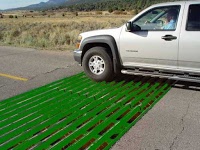
Cattle Guard

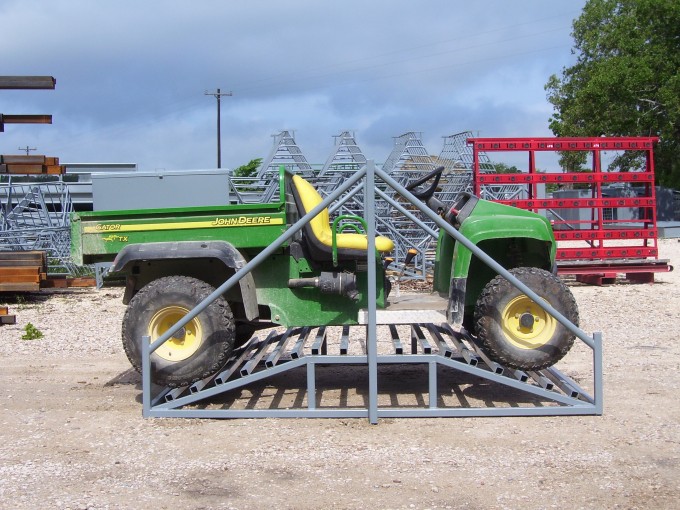
side view of atv on a cattle guard

ATV Cattle Guard for Pasture Fence Line

Facebooktwitteryoutube

Livestock Waterers at Barn World

Livestock waterers are important for keeping your animals for health and weight gain.   Barn World has a wide selection for all you animal waterer needs.

BIGspring - ENERGY FREE WATERER - 60 Gallon with heat
BIGspring – ENERGY FREE WATERER – 60 Gallon with heat

The large 60 gallon Big Spring Waterer is a constant-flow watering system ideally suited for free-stall dairy operations and large feedlots. If you raise beef or dairy cows, the BIGspring model is perfect to fit your needs.

LilSpring WATERER - Double-Sided 6 GAL (with heat in GREEN)
LilSpring WATERER – Double-Sided 6 GAL (with heat in GREEN)

Smaller waterers in the Lil Spring waterer models are ideal for small animals or groups of small animals — such as goats, llamas, ponies, horses, and many others. Lil’Spring models can accomodate multiple pens by installing them in a split-fence application.   We offer them as single or double sided waterer.

MiraFount - ENERGY FREE WATERER - 4 HOLE Removable
MiraFount – ENERGY FREE WATERER – 4 HOLE Removable

Our Energy-Free Waterers:

E-Founts are the most economical electric heat waterers available today. The E-Fount is equipped with a 50 watt heat element and thermostat. E-Founts only require 4 kilowatts of electricity during a week of -25 degree F temperatures. This model is ideally suited to operations with just a few animals drinking infrequently or if extreme cold weather conditions are persistent.

We also offer the MiraFount models which are patterned after their first energy-free livestock watering systems, built more than 30 years ago. These small. medium and large capacity watering systems are ideal for beef operations, dairy herds and other livestock.

Hog and Pig Waterers

Hog Waterers

We also have utility Hog Waterers in 80 and 35 gallon sizes.  The hog waterer is:

  • Made of 100% non-porous polyethylene – will not rust, rot or corrode.
  • Confinement pen acids have no effect – waterers last and last.
  • Quick and easy cleaning – no pans or shields to remove from drinker trough.
  • Big hogs drink with ease from 18” wide x 17” high x 9 fl” deep drinkers.
  • Trough height from floor is 6”, so little pigs drink easily.
  • No cracks, corners or crevices to collect sediment or bacteria.
  • Each drinker has a drain plug, so washing and flushing is fast, simple and complete.
  • One dependable float and valve handles both drinkers.
  • Heavy steel-plated chew guard protects trough lip.
  • Gallon capacity calibrations molded into tank wall.
  • Float and valve completely protected from hogs.
  • Remember to keep your animals healthy with a animal waterer from Barn World.  Visit BarnWorld.com for all your livestock equipment needs.

    Facebooktwitteryoutube