How to Install a Cattle Guard

Every long-lasting building requires a solid foundation and a cattle guard installation is no different. It carries heavy loads with shifting weights and it’s extremely important that it’s installed on a proper foundation correctly.

We strongly recommend that a contractor familiar with the local site conditions be used for a proper installation. Typical site considerations include frost levels, drainage, type of soil, and even local building codes. All of these factors are important to take into account for a long-lasting trouble-free cattle guard crossing.

Generic Foundation Diagram
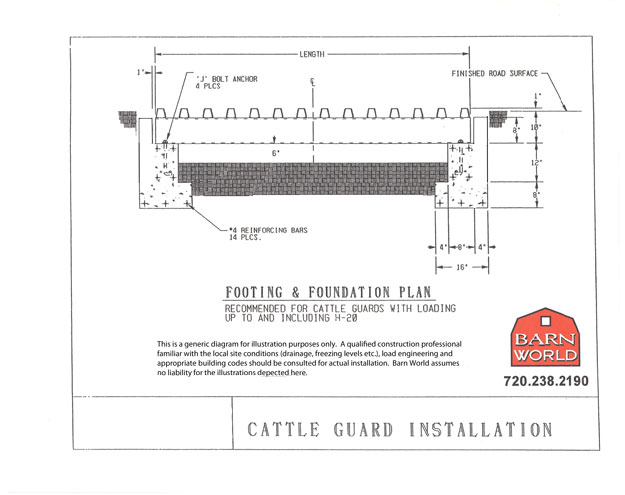
cattle guard foundation diagram

Excavation of the Vaulted Area

The vaulted, or dug-out area beneath the grid is key to providing the often overlooked optical barrier that dissuades livestock from even touching the top rails. Allowing the animal to view the bottom of the excavated area provides a conflicting depth perception created by the contrast with the top rail. This optical confusion (near and far at the same time) can be an effective visual deterrent all on its own.

Painted Guards

Studies have shown the illusion of a three-dimensional grate when painted across a roadway. and sometimes be effective at preventing crossing by itself. In the studies, cows were introduced to the fake barrier and almost all of them refused to cross initially. The trouble with the painted illusion was when one did eventually work up the courage to test the perceived barrier, it was able to walk over it without trouble. This then gave courage to the remaining livestock and they also soon followed.

The vaulted area is created by removing soil under the top rails to create a visual deterrent and allow debris to fall through. We typically recommend at least 6″ be dug below the bottom support beams as shown in the diagram. With a 12″ overall height, a depth of 18″ from the top rail to the bottom of the vault will be presented to the livestock. You may go deeper if desired, the important issue is that the foundations themselves are properly supported.

The vault also helps prevent debris from collecting between rails. If the vacant area beneath wasn’t there, dirt and debris would fill the area between the top rails, and the barrier would lose its effectiveness and become a livestock walkable bridge.

To help with drainage, the bottom of the vault should include a means of allowing water to drain away from the installation without disturbing the surrounding footings. Typically crushed gravel is used to create a french drain. Because every site is unique, a contractor familiar with the local conditions should be consulted.

Foundations

Concrete footings are usually poured on site but we do also offer precast concrete cattle guard foundations that can be shipped right along with our flat rail cattle guards.

cattle guard on top of concrete foundations

The concrete is designed to fit pre-drilled holes in the guard so they can be bolted down upon arrival. Quick, easy, and convenient, they’re becoming a more popular option for sites that don’t want to pour their own.

Surface Installation with a Boxed Cattle Guard

Boxed cattle guards are set directly on the ground and are designed for low traffic, remote and temporary installations. The box is a steel skirt welded to the perimeter to keep dirt from getting in underneath. Dirt is pushed up on either side of the guard to create a ramp for crossing vehicles.

Boxed Cattle Guard

a boxed cattle guard

This design is popular in remote areas like cell phone towers and oil wells. They’re also used at construction site entrances as rumble strips, washouts for cleaning equipment, and keeping the entrance clear of mud.

Although they lay directly on the ground, site preparation and proper drainage are a must. A bed of crushed gravel can go a long way to removing excess water and keep if from eroding your cattle crossing.

Site Specific

Foundations are critical to keeping your livestock barrier in place and working effectively. They secure the guard from moving and transfer the passing load to the ground. The above recommendations should be considered and a local contractor consulted for a long-lasting installation.

If you have any questions or would like help planning your project, please visit BarnWorld.com or contact us anytime and we’ll be happy to assist.

Facebooktwitteryoutube

Cattle Guard Synonyms

There are many names for what we, in the American West, call cattle guards. These effective livestock barriers are a simple series of parallel bars, made with either square or round top rails that are set in the ground across a road. They allow a vehicle tire to simply roll across the gaps created between the top rails while providing a physical deterrent for flat-hoofed animals.

Cattle Guard Installation

cattle guard with wings diagram
Sometimes, they’re ironically called cattle crossings but they’re actually anything but that. They’re designed to prevent livestock from crossing and not to provide a crossing for cattle!

In New Zealand, they are more appropriately called cattle stops and in the United Kingdom can be known as a cattle grid. Australians commonly refer to them as cattle grates and other names in the US include the Texas Gate, livestock guard, and cattle grill. As long as they keep your cattle from wandering away, any name will do.

Construction

Even though they’re called different names, they’re both available in steel and concrete. Steel is by far the most common material and they’re seen in use around the county. Concrete offers great flexibility for private use and can be much more economical than steel. They can also be highway-rated like steel.

Steel

The most common construction material is steel pipe. The pipe, also known as rails, is available in both flat and round rails. The top rails for the flat top guards are shaped like hexagons and create a flat surface for rolling tires. They’re good for high-speed traffic areas and give a smoother ride to crossing vehicles.

The round is a little more aggressive for livestock. and the concrete can be placed just about anywhere!

Concrete

Visit Barn World and see our large varieties of whatever you prefer to call them. We have the right configuration for private use as well as highway ratings from the AASHTO for your operation. We can help with any decisions you may be facing.

If you have any questions about them or would like a quote with delivery right to your project site, just let us know and we’ll be happy to help!

Barn World may be reached at Sales@BarnWorld.com and 720-238-2190.

Facebooktwitteryoutube

How is a Cattle Guard delivered?

Cattle guards can be one of the most useful time savers when crossing through a fence line. They don’t require you to stop and open a gate only to pull forward and do it all over again. You know how it goes, it’s most likely in deep snow and during a downpour! However, once installed, these long-lasting, set-and-forget livestock barriers can be the ultimate in convenience for you, your equipment, and your guests.

Below are some quick explanations of what to expect regarding the delivery and unloading process for these large cattle grids.

Concrete Foundations

cattle guard on concrete foundations

How is a cattle guard delivered?

Cattle guards are very large, one-piece steel structures that require a long, heavy-duty delivery vehicle. Typically a semi-truck is used which can raise some issues.

Entry and Exit

Due to their long trailer lengths, access to a large delivery and unloading area is necessary. This requires easy entry and exit from the site so the rig may pull through or use a large turn-around area to leave.

Unloading Equipment Requirements

The large weights involved also require that the receiver is able to provide a mechanical means of unloading upon arrival. The delivery vehicle and driver are unable to unload them from the truck so equipment must be present when the delivery is made.

From a shipping perspective, cattle guards are very large and extremely heavy., very heavy, and therefore expensive to ship. They are usually shipped by a freight company on a semi-truck. They can either be shipped inside a box trailer or on a flatbed trailer. If you include the wings, they must be shipped on a flatbed trailer. Consider buying a cattle guard with bolt-on wings as they can be shipped by either flatbed or box trailer and stack nicely. The bolt-on feature allows for more economical shipping are easy to install in the field.

Make sure you have the ability to unload the heavy cattle grid from the trailer when you arrange your delivery date as the freight trucks do not have any kind of un-loader.  You must have a forklift or front-end loader ready when it arrives.

Call Barn World with your cattle guard questions at 720-238-2190 or email Sales@BarnWorld.com today!

Facebooktwitteryoutube

Using Cattle Guards for Deer

cattle guard

We get a lot of questions about whether a cattle guard can be effective at keeping deer from entering a property. The answer is yes, and no.

Most people think of deer as quaint and harmless animals, and they can be. Truth be told, they can also cause a lot of damage to landscaped vegetation, such as your prized flowers and expensive plants. They can also be an irritant to pets as well as a physical danger to people and animals during rutting season.

Unfortunately, it’s extremely difficult to keep them at bay because they’re so athletic. They’re very able jumpers and can easily leap long distances and clear tall heights.

Cattle Guards for Deer Need to be Imposing

To provide an effective barrier and dissuade them from simply jumping over a cattle guard, an extra distance must be created. Typically two are placed side-by-side to create a 12′ – 16′ distance in the direction of vehicle travel. We’ve found that this distance is usually enough to discourage them from attempting to jump across. At Barn World, we do offer pre-drilled guards so they may be bolted together on-site and easily provide the distance needed.

With deer, you want to make sure the barrier is imposing and daunting enough so they don’t attempt to cross. If it’s a distance they think they might be able to jump and aren’t successful, they may become entangled in the guard. They have more slender hooves and legs than livestock and can slide down between the top rails. This presents a dangerous situation where they can injure themselves during a struggle to get out.

Check your fencing for height

Even with the extended distance of two guards on the ground, you’ll also need to be sure your perimeter fencing is tall enough to keep them from jumping over. They’re incredibly good at jumping vertically as well as horizontally.

Cattle Guards and Horses Don’t Mix 

As a quick side note, we do not recommend using cattle guards with horses. A lot of people have used them for years with horses without incident, but the potential risk of injury can be severe. Like deer, they too have a smaller hoof and a slender leg that can slide between the top rails. If that happens, the leg is then exposed to breakage and it can be extremely difficult to get them out. Most horses won’t test the uneven surface of a cattle guard but it’s best not to risk losing your animal, use a gate instead.

If you have any questions about cattle guards, please call (720) 238-2190 or email Barn World at Sales@BarnWorld.com anytime and we’ll be happy to help!

cattle guard installed in roadway for livestock

Facebooktwitteryoutube