
Hay Tarps




Recently viewed
Hay Tarps and Bale Covers for Outdoor Hay Storage
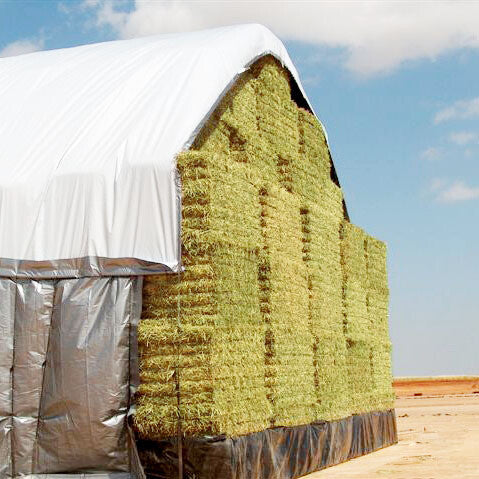
Putting up quality hay takes time, equipment, fuel, and money. That investment continues after baling: forage must be moved, stacked, stored, and kept usable until the livestock need it. When a stack sits outdoors, rain, snow, sunlight, and moisture rising from the ground can weather the outer layers and increase feed losses. A properly selected hay tarp helps shield bales from direct precipitation and exposure when a permanent hay barn is unavailable or impractical.
Successful outdoor hay storage requires more than throwing waterproof material over a pile. Hay should be adequately cured before covering, the stack must shed water, the ground below must drain, and the tarp must stay firmly secured as the weather changes and bales are removed. Barn World offers 15-mil Bull Flex and 17-mil Performer bale covers along with tie-down equipment, replacement parts, and side curtains. The following guide explains how to select a cover and use it effectively.
Why Cover Hay Stored Outdoors?
Rain and melting snow can penetrate exposed bale surfaces, reducing palatability and contributing to spoilage. Wet hay at the bottom of a stack can also deteriorate through prolonged soil contact. Even if the center of a bale remains usable, damaged outer forage represents feed that was grown or purchased but cannot be recovered. Protecting the stack can help preserve a greater share of the hay you have already paid to produce and handle.
Potential savings depend on local rainfall, storage duration, forage quality, bale density, and how the hay is stacked. The goal is to reduce avoidable weathering, not to promise zero losses. A tarp will not correct hay that was baled too wet, and it cannot substitute for drainage, ventilation, monitoring, or good feeding practices. In many operations, a dependable cover is a practical middle ground between leaving hay fully exposed and building a permanent storage structure.
Compare Bull Flex 15-Mil and Performer 17-Mil Hay Tarps
The two main tarp styles in this collection differ in fabric thickness and attachment details. Bull Flex is a 15-mil tarp and Performer is a 17-mil tarp. A mil is one thousandth of an inch, not a millimeter. Thickness is one product characteristic, but it does not by itself determine how long a cover will last, how it should be secured, or whether it will withstand a particular wind event.
| Feature | Bull Flex | Performer |
|---|---|---|
| Listed thickness | 15 mil | 17 mil |
| Fabric | UV-resistant coated woven polyethylene | UV-resistant coated woven polyethylene |
| Attachment approach | Reinforced attachment points and end pockets; choose a compatible tie-down arrangement | Sleeved PVC sections, rope, and Super Cinch components described with the assembled tarp |
| Before ordering | Verify cover size and separately required securing hardware | Verify cover size and exactly which components are included |
Review the current listing for the size and model you intend to purchase. Some tie-down kits are separate products, and the exact rope, hook, cinch, or reinforcement arrangement can vary. Do not assume all hay tarps have the same accessories or warranty terms.
Bull Flex Hay Bale Covers
Bull Flex is a 15-mil coated woven polyethylene cover for appropriately built round- or square-bale stacks. Its reinforced securing points allow the cover to be restrained using the compatible attachment system. Select the necessary hardware for the shape and location of your stack, and confirm whether the chosen tarp size requires any separately purchased installation parts.

Performer Hay Bale Covers
Performer is the 17-mil option. Its listed construction incorporates sections of PVC pipe held in sleeves and a rope-and-cinch securing arrangement that helps distribute tension along the edge. Follow the product-specific deployment and tightening directions so fabric seams and attachment points are not unnecessarily strained.

Select a Storage Site That Drains
The ground under a haystack matters nearly as much as the material above it. Moisture can move into the bottom layer even when the tarp keeps rainfall off the top. Choose a high, well-drained location rather than a low spot, drainage path, or area where snowmelt collects. The ground should support the weight of stacked bales and provide safe access for tractors, loaders, and delivery equipment.
A properly prepared gravel pad or other stable, well-draining base may help limit moisture contact. Suitable pallets, timbers, or other supports can be useful in some setups, but they must safely carry the bale weight without shifting or causing the stack to tip. Evaluate runoff from higher ground, too: a storage pad that sits downhill from a roof or roadway may receive more water than the site itself appears to collect.
Underlayment and side curtains can provide additional protection as part of a correctly designed storage system. Their overlaps should direct water away from the hay rather than trapping it beneath the bottom bales. Check the installation instructions for the particular materials being used; a waterproof underlayment installed without an escape path for water may create a moisture problem rather than solve one.
Make Sure Hay Is Dry Enough Before Covering
A hay tarp is a protective cover, not a hay dryer. Bales containing excessive moisture may heat, mold, or deteriorate under a cover. In severe cases, internal heating in inadequately cured hay can become a fire hazard. Safe moisture targets depend on the forage, bale size and density, and storage method. Measure moisture appropriately, follow local agricultural-extension recommendations, and monitor newly stored hay when conditions warrant.
Do not assume that hay is safe to cover because the outside feels dry. A bale can contain wetter interior material, and stacks with poor air movement may retain moisture. If hay smells musty, shows visible mold, has unusual heat, or has other signs of spoilage, investigate before offering it to livestock. A tarp may help reduce outside wetting, but it does not reverse deterioration that is already occurring inside the bale.
Build a Stable Stack That Sheds Water
A well-shaped stack helps the cover work as intended. Arrange bales so that the top has a suitable slope and the tarp can drain without forming pockets. A deep depression between bales may collect water, allowing its weight to pull against the fabric and seams. Correct the stack shape before installation instead of relying on extra tension to bridge an unsupported gap.
For round bales, consider how the bale arrangement creates a curved profile across the top and down the sides. For large square bales, use a stable stacking pattern and account for the height of each layer. Follow safe stacking practices for the machinery, bale weight, and site. Keep people away from unstable stacks, and never climb onto an unsecured pile in windy or icy conditions.
Position the stack to allow routine access and future removal of hay. A cover can become harder to manage once part of the pile has been consumed. Planning the feeding sequence before covering may reduce the amount of fabric that must be moved, folded, or retensioned every time another group of bales is taken out.
How to Measure a Hay Stack for a Tarp
Hay tarp size should be selected from the actual length of the stack and the distance over its top and down the sides, not simply from the width measured across the ground. A rounded or peaked stack requires more fabric to follow the contours than a flat horizontal measurement would indicate.
Measure the full length of the hay pile, including the planned end coverage. Next measure the cross-section from the desired lower edge on one side, over the highest point, to the desired lower edge on the opposite side. Consider how much side coverage is needed for the selected storage arrangement and where the securing points will fall. Compare these measurements with the current sizing chart for the exact tarp style.
For square bales, allow for tier height and whether the top is flat or peaked. For round bales, allow for bale diameter, number of rows, and the curvature of the stack. Make sure the chosen cover provides practical attachment positions without leaving large sections of loose fabric. Additional fabric is not always beneficial if it flaps in the wind, lies in standing water, or interferes with the intended tie-down method.
If the stack will grow through the season or shrink as bales are removed, think ahead about how the cover will be adjusted. A tarp that fits one arrangement well may require folding and securing when half the stack has been removed. Review the manufacturer's recommended method for covering a changing stack.
Install a Hay Tarp for Water Runoff and Wind Resistance
Lay the cover over the prepared stack according to the model's instructions, centering it so the available fabric and tie-down points are distributed appropriately. Remove major folds that could hold rainwater. Anchor the cover with the proper system, working methodically around the stack to avoid one side becoming much tighter than the other.
A properly restrained tarp should be snug enough to minimize flapping while avoiding unnecessary stress on reinforced points, sleeves, or seams. Wind-driven movement can rub fabric against bale edges and gradually wear a hole. At the same time, excess force on a rope or cinch can damage hardware or pull on the fabric. Follow the maker's instructions for tensioning and anchor placement rather than using an arbitrary tightening force.
Inspect the tarp soon after installation and again after strong wind, rain, or snow. Check for loose ropes, shifted anchors, new folds, and places where water is pooling. Keep away from electrical lines, overhead obstacles, and loose fabric during high winds. Large hay tarps can catch the wind suddenly; do not attempt to deploy or adjust one in hazardous weather.
Ropes, Cinches, J-Hooks, and Tie-Down Kits
A tie-down system is an essential part of a reliable hay cover. Depending on the tarp and bale arrangement, components may include UV-resistant rope, adjustable Super Cinch devices, approved hooks, reinforced webbing, and other anchors. Their purpose is to maintain tension and reduce fabric movement as temperature, weather, and the stack shape change.
Do not assume that every hook should be attached directly to baling twine. Twine strength and stack construction vary, and an insufficient anchor can fail under load. Use only the anchoring method specified for the tarp and chosen kit. Similarly, an elastic or improvised restraint may permit repeated tarp movement rather than holding it firmly in place.
Choose the round-bale or square-bale tie-down configuration that matches the cover and stacking method. Verify the included quantities and parts before ordering; separate products in this collection include cinches, rope, J-hooks, and complete tie-down kits. These accessories do not need to be bought twice if they are already included with the selected tarp assembly.

When Side Curtains and Underlayment Help
Top coverage addresses direct precipitation on the hay pile, but wind-driven rain can also reach the exposed sides. Side curtains may improve protection where the selected stack design allows them to be installed securely. They can also help manage runoff around a larger square-bale stack when used with a compatible ground-protection system.
Underlayment is intended to help separate hay from ground moisture, while the main tarp shields the upper surface. These are different jobs. Neither accessory should block drainage or trap moisture within inadequately dried hay. Plan the overlap between upper cover, side curtain, and ground material so that water is directed away from the stack, not into it.
Confirm fabric dimensions, fastening points, and compatibility before combining components from different systems. A curtain that reaches the ground but remains loose can collect mud or be damaged by equipment. Make sure the finished arrangement permits safe access to the hay and routine inspection.
Inspect, Repair, and Store Hay Tarps
Regular checks help protect both the tarp and the forage beneath it. Inspect tie-down tension after weather events and when bales are removed. Look for abrasion where the fabric contacts rough edges, as well as punctures, worn seams, loose reinforcement, or damaged anchors. Make small repairs promptly using material and tape compatible with the cover and the manufacturer's recommendations; replace sections that cannot be repaired safely.
When the tarp is removed at the end of the season, clean off loose debris and allow the cover to dry thoroughly before folding or rolling it. Do not store a damp tarp tightly packed for an extended period. Follow the fabric manufacturer's storage directions, keep it away from sharp edges and rodents where practical, and label the folded cover by size so that it can be matched to the next stack.
How long a tarp remains useful depends on exposure, handling, installation, maintenance, and the specific material. UV resistance and reinforcement help, but they are not guarantees against storm damage, wear, or deterioration. Review current warranty terms for the chosen product rather than assuming every model has the same duration or conditions.
Estimate the Value of Protecting Hay
The cost of a tarp should be weighed against the value of the forage being protected and the expected period of outdoor storage. Consider the number of bales, estimated usable hay weight, replacement cost of forage, weather exposure, and the cost of securing, inspecting, and maintaining the cover. Include any underlayment, side curtains, and installation supplies that are not part of the tarp itself.
A simple way to evaluate the decision is to compare the total covering expense with the value of hay that might otherwise be lost to weathering. The percentage of hay saved will vary and cannot responsibly be guaranteed for every operation. Even when a cover provides an economic benefit, monitoring hay quality remains necessary; preserving a tarp's appearance is not the same as preserving the safety and feed value of the hay beneath it.
Planning a Hay Tarp Order from Barn World
Before requesting a quote, note whether the stack contains round or square bales, the bale dimensions, the final stack length, and the distance over the top and down the sides. Identify the preferred Bull Flex or Performer model, the expected storage location, and whether side curtains, underlayment, or separate tie-down components are needed.
Provide your delivery ZIP code and the number of covers required. Check the individual product listing for current size choices and included hardware. This makes it easier to compare options and estimate the complete delivered cost rather than purchasing a tarp first and discovering later that the size or securing equipment is unsuitable.
Frequently Asked Questions About Hay Tarps
Can a hay tarp prevent all mold and spoilage?
No. A cover can limit direct wetting from precipitation, but it cannot dry hay that was baled too moist, eliminate moisture from the ground, or guarantee safe storage. Proper curing, drainage, ventilation, and monitoring are still necessary.
What is the difference between 15-mil and 17-mil hay tarps?
These labels refer to listed material thickness, measured in thousandths of an inch. Barn World's Bull Flex cover is 15 mil, while the Performer is 17 mil. Their attachment details also differ, so compare the complete product and accessories instead of using thickness alone.
How do I know what size cover fits my bale stack?
Measure the stack length and the distance from the desired edge on one side, over the top, to the desired edge on the other side. Account for bale dimensions, stack shape, and the tie-down arrangement. Compare the measurements with the selected product's size guide.
Can the same tarp cover round and square bales?
Some tarp styles can be used for either arrangement, but the shape, size, and anchoring method may differ. Confirm that the specific cover and tie-down kit suit the way your bales are stacked.
Is underlayment necessary if I already have a top tarp?
A top tarp and an underlayment address different moisture sources. The top cover limits rainfall on exposed hay, while underlayment or a prepared storage pad may reduce ground moisture reaching the bottom bales. Whether both are useful depends on site drainage and the storage arrangement.
Why does a hay tarp need to be retightened?
Ropes, attachments, and the stack can settle or shift as the weather changes and hay is removed. Periodic checks help prevent loose fabric from flapping, chafing, or collecting water. Follow the manufacturer's adjustment instructions.
Can I put a tarp over freshly baled hay?
Only when the hay is adequately cured for safe storage. Covering bales with excessive internal moisture may retain heat and moisture, increasing spoilage and potentially creating a fire hazard. Verify suitable moisture conditions for the forage and bale type.
What should I check before ordering a heavy-duty hay cover?
Confirm material style, stack shape, required cover dimensions, included and separate tie-down hardware, drainage arrangements, unloading or delivery needs, and warranty terms. Providing these details with your ZIP code helps Barn World prepare an appropriate freight quote.