
https://www.barnworld.com/livestock-supplies/?cat_link=Heating-Pads
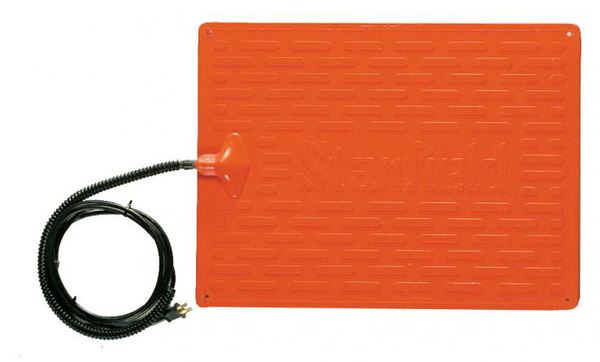
The durable heat pad is made with a fiberglass-engineered reinforced plastic composite material that is 100% water-tight, very easy to clean, and is also flame-retardant. The raised treading surface provides sure-footing for piglets and other small animals.
SCROLL DOWN FOR PICTURES AND DETAILS
Stanfield Farrowing Heat Pads
The Stanfield Farrowing Heat Pads provide a safe, reliable, and economical solution for keeping newborn pigs warm, promoting healthy growth, and preventing crush losses. Engineered with flame-resistant, fiberglass-reinforced composite material, these heat pads are fully water-tight and designed to block chilling drafts from the floor. The pads feature a treaded surface to provide piglets with a sure footing while evenly distributing warmth across a uniform lying area, maintaining temperatures 30-35°F (16-20°C) above ambient air. This helps create a cozy environment for piglets, keeping them away from the sow to reduce the risk of the piglets getting crushed or rolled on.
They are built to last, featuring a double-insulated, sealed heating element that ensures durability and safety. Each pad is water-resistant, fire-retardant, and can serve up to nine animals with a maximum power output of 95 watts. For enhanced energy efficiency, there are compatible power controls (see options above), enabling users to adjust pad temperatures lower based on barn conditions. These mats are ideal for use in farrowing barns maintained at 60-70°F (15-22°C), where the surface temperature of the pad will reach 90-100°F (32-38°C) at full power. If the surrounding air temperature rises, the optional thermostats can be used to lower the pad temperature and help save energy as well.
With no need for additional bedding, these durable pads provide direct, steady warmth, eliminating the cost and maintenance associated with extra layers. Temperature adjustments may be necessary depending on the ambient barn temperature and animal behavior. If piglets move toward the sow, the pad may be too cool, while behavior like defecating on the pad indicates it may be too warm. Simple adjustments to barn temperature or the use of Osborne Heat Pad Controls ensure optimal conditions. Keeping a clean pad is a must.
To maximize longevity and safety, it is recommended to anchor the heat pads securely, using either Osborne Smart-Fasteners for slotted floors or simple tie-downs for other surfaces. Adding caulk around the edges of the mat can also help prevent moisture buildup underneath.
See our Nursery Heating Pads here!
Features & Benefits
- Keeps piglets away from the sow to reduce crush losses
- Increases gain and weaning weights
- Decreases energy costs
- Maintains a constant, uniform resting surface 30-35°F above air temperature at full power
- Available Optional Temperature Controllers
- Safe and durable – double-insulated heating element is fully sealed in composite material
- Water-resistant and fire-retardant construction
Specifications
- Size: 1.5 x 2 ft. (0.46 x 0.61 m)
- Animals Served: Up to 9
- Maximum Power Output: 95 watts
- Voltage: 120V
- Power Cord: 10 ft. (3 m)
- Maximum Energy Used: 2.28 kWh/Day
- Temperature: 30-35°F (16-20°C) above air temperature
Usage Tips
Stanfield Heat Pads are designed to provide a warm sleeping area rather than heat an entire barn. If the air temperature drops too low (below 60°F [15°C]), additional heating may be necessary to prevent chilling.
For accurate temperature management, observe piglet behavior on the pad. If they huddle near the sow, increase the barn temperature or the heat mat setting. Conversely, if they avoid the center of the pad, it may be too warm. Adjust settings accordingly for optimal comfort.
Installation
To secure the heat pads, anchor them through predrilled holes or add holes at the dimpled locators. Use Osborne Smart-Fasteners on slotted floors or simple tie-downs. On solid concrete, use expansion bushings and screws. Apply a bead of caulking compound around the outer edge to keep moisture and residue from accumulating under the mat.

Animal Heating Pad Instructions
These pads provide a warm lying area for small animals, particularly important for piglets and other animals that are born without adequate body temperature regulation or hair-coat protection.
Warning
- Large animals or improper handling can damage power supply cords and heat pads, leading to life-threatening electric shock hazards or potential fire risks if combustible materials are nearby.
- Do not allow adult animals access to power cords or heat pads.
- Avoid carrying heat pads by their power cords.
- Do not use heat pads near combustible materials.
- Always disconnect the power when washing heat pads.
- If damage is detected, remove the heat pad from service and return it to Osborne Industries for inspection and repair.
Note: Only qualified factory personnel should perform heat pad repairs. Contact your Osborne dealer or Osborne Customer Service for repair details.
Installation
Osborne Stanfield® Heat Pads should be installed in a dry, well-drained location using the predrilled holes. Additional anchor holes can be drilled around the outer margin at the dimpled locators only; drilling holes elsewhere may damage the heating element. Ensure power cords are kept out of reach of animals, and use a conduit, such as an Osborne Cord Protector, plastic pipe, or electrical conduit, for added protection. Damages from insufficient cord protection are not covered by warranty and may cause hazardous electric shocks.
Warning: Always protect the heat pad from adult animals and secure it to prevent movement. Protect power cords from access by both adult and small animals.
Operation
Osborne Stanfield® Heat Pads do not have an internal thermostat. At full rated input voltage, they operate at a fixed temperature rise above ambient air, suitable for piglets and small animals when the room temperature is 65-70°F (18-21°C). For year-round control and efficiency, it is recommended to use an Osborne Heat Pad Control to manage power and temperature.
Caution: For animals with hair or fur, such as puppies, calves, and lambs, always use temperature controls to ensure the pad is set at a safe level. Excessive heat can cause injuries in some animals.
Troubleshooting
If animals are not using the heat pad, consider the following:
- Power Check: Ensure electrical power is connected. Place your hand on the pad for several seconds to feel a “warm” sensation if power is active.
- Drafts: If the pad is warm but unused, check for drafts in the area compared to where the animals rest. Adjust ventilation to reduce drafts as needed.
- Temperature: If animals appear restless, lie near the pad but not on it, or use it intermittently, the pad may be too warm. Lower the air temperature or adjust the controls to a comfortable level.
To ensure long-lasting performance, always keep the heat pad clean and dry.
Photo Gallery


